Professional epoxy flooring systems manage Fort Myers epoxy flooring humidity challenges through moisture vapor barriers, calcium chloride testing, and specialized primer systems designed for subtropical conditions. The Caloosahatchee River corridor creates a unique microclimate where relative humidity regularly exceeds 80% and concrete slabs absorb moisture from both above and below. According to the American Concrete Institute (ACI), concrete in coastal Southwest Florida can transmit up to 25 pounds of moisture vapor per 1,000 square feet every 24 hours, making proper moisture management essential for coating adhesion.
Garages within three miles of the Caloosahatchee face amplified humidity exposure compared to inland properties. This proximity affects concrete moisture content year-round, not just during summer months. Understanding how professional epoxy systems address these conditions helps homeowners make informed decisions about floor coatings that will actually last in riverfront and near-river environments.
The Caloosahatchee River Humidity Challenge
The Caloosahatchee River stretches 67 miles from Lake Okeechobee to the Gulf of Mexico, passing directly through Fort Myers and creating one of Florida’s most humidity-intensive residential corridors. The South Florida Water Management District reports that water releases from Lake Okeechobee can increase local humidity by 8-12% above regional averages during wet season, directly impacting homes from Cape Coral to Estero.
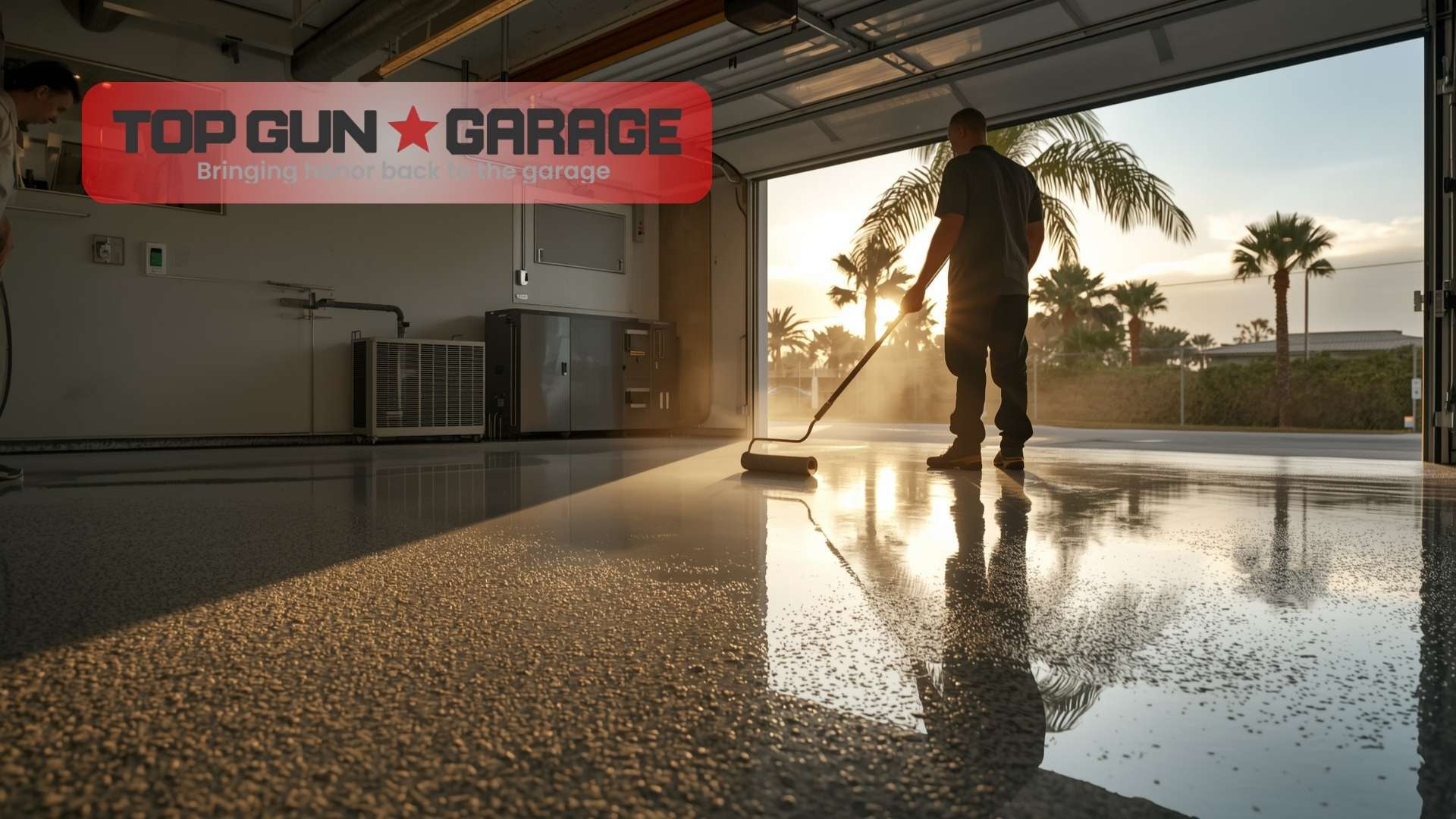
This river system affects garage floor coatings in three critical ways. First, ambient humidity penetrates concrete from the surface during daily temperature cycling. Second, the high water table throughout Lee County pushes moisture vapor upward through slabs. Third, frequent afternoon thunderstorms from May through October create rapid humidity spikes that stress coating adhesion bonds.
Properties in neighborhoods like McGregor Boulevard, Fort Myers Shores, and Riverside face the most intense exposure. The National Weather Service data shows Fort Myers averages 74% relative humidity annually, but riverfront areas consistently measure 5-10 percentage points higher during morning hours when condensation risk peaks.
How Humidity Damages Unprotected Epoxy Floors
Humidity attacks epoxy coatings through multiple mechanisms. Understanding these failure modes explains why standard epoxy systems often fail in Caloosahatchee River communities while properly specified systems last 15-20 years.
Moisture Vapor Transmission (MVT)
Concrete is porous. Water vapor constantly moves through slabs from the ground below toward the air above, driven by vapor pressure differentials. When this vapor encounters an impermeable epoxy coating, it becomes trapped at the concrete-coating interface. Pressure builds until the bond fails, creating blisters, bubbles, and eventually delamination.
The International Concrete Repair Institute (ICRI) sets the acceptable MVT threshold at 3 pounds per 1,000 square feet per 24 hours for most epoxy systems. Testing in Lee County garages frequently reveals readings of 8-15 pounds, requiring mitigation before any coating can succeed. Properties closest to the Caloosahatchee often test even higher during rainy season.
Surface Condensation Issues
When humid air contacts a cool concrete surface, moisture condenses directly onto the slab. This phenomenon occurs most dramatically during spring and fall mornings when overnight temperatures drop below the dew point. The thin water film that forms prevents proper epoxy adhesion during installation and undermines existing coatings over time.
Professional installers monitor both concrete temperature and dew point throughout the application process. The concrete surface must remain at least 5 degrees Fahrenheit above the dew point to prevent condensation. In Fort Myers, this requirement often limits installation windows to late morning through early afternoon during transitional seasons.
Amine Blush Formation
Amine blush occurs when humidity reacts with the amine curing agents in epoxy coatings during the curing process. The reaction creates a waxy, whitish film on the surface that compromises adhesion of subsequent coating layers and creates an unattractive cloudy appearance. This phenomenon affects both DIY applications and professional installations when humidity controls are inadequate.
According to research from the Society for Protective Coatings (SSPC), amine blush formation accelerates dramatically above 70% relative humidity. Fort Myers exceeds this threshold approximately 280 days per year, making amine-resistant formulations and controlled curing environments essential for successful installations.
Humidity Impact on Epoxy Systems
The following table shows how different humidity levels affect epoxy performance:
Humidity Level
Installation Risk
Mitigation Required
Below 50%
Low
Standard procedures
50-65%
Moderate
Timing adjustments
65-80%
High
Dehumidification + MVT barrier
Above 80%
Very High
Full moisture management system
Professional Moisture Testing Methods
Accurate moisture assessment forms the foundation of successful epoxy installation in humid environments. Professional contractors use multiple testing methods to build a complete picture of slab conditions before recommending coating systems.
Calcium Chloride Testing (ASTM F1869)
The calcium chloride test measures moisture vapor emission rate (MVER) from concrete surfaces. A sealed dish containing anhydrous calcium chloride crystals sits on the prepared concrete surface for 60-72 hours. The crystals absorb moisture vapor, and the weight gain calculates the emission rate in pounds per 1,000 square feet per 24 hours.
ASTM F1869 requires testing at a rate of three tests per first 1,000 square feet plus one additional test for each additional 1,000 square feet. A typical two-car garage requires at least three test locations. Results above 3 lbs/1,000 sf/24 hrs indicate the need for moisture mitigation. Learn more about concrete moisture testing for epoxy installation.
Relative Humidity Testing (ASTM F2170)
The in-situ relative humidity test provides a more comprehensive assessment of moisture conditions throughout the slab depth. Holes are drilled to 40% of the slab thickness, lined with sleeves, and allowed to equilibrate for 72 hours before measurement. Digital probes then record the relative humidity at that depth.
Most epoxy manufacturers specify maximum acceptable RH readings between 75-80%. Fort Myers concrete commonly tests between 85-95% RH at the 40% depth, particularly in slabs poured directly on grade without vapor barriers. This testing method has become the industry standard because it predicts long-term moisture behavior more accurately than surface tests.
Plastic Sheet Test (ASTM D4263)
While not as precise as quantitative methods, the plastic sheet test provides quick preliminary assessment. An 18-inch square of polyethylene plastic is taped to the concrete surface for 16-24 hours. Moisture accumulation under the plastic indicates potential vapor transmission issues.
Professional contractors often use this test during initial site visits to identify obvious moisture problems before scheduling formal testing. In Fort Myers riverfront properties, this simple test almost always reveals visible condensation, confirming the need for comprehensive testing.
Moisture Mitigation Solutions for Caloosahatchee Properties
When testing reveals elevated moisture levels, mitigation systems create barriers that allow epoxy coatings to perform properly. The specific system selected depends on moisture severity, budget, and timeline constraints.
Epoxy Moisture Barrier Systems
Two-component epoxy moisture barriers create impermeable films that block vapor transmission from below while allowing the decorative topcoat to bond properly. These systems typically handle MVT rates up to 15-20 lbs/1,000 sf/24 hrs, sufficient for most Fort Myers residential applications.
Application requires thorough concrete preparation, typically diamond grinding to CSP 2-3 profile. The barrier coat cures for 12-24 hours before topcoat application. Quality moisture barrier systems add $1.50-$3.00 per square foot to project costs but prevent the far more expensive failure and replacement cycle. Understanding how moisture barriers work under Florida epoxy helps homeowners evaluate contractor proposals.
Polyurea and Hybrid Systems
Polyurea coatings offer superior moisture tolerance compared to traditional epoxies. These systems can handle higher residual moisture during installation and demonstrate better long-term resistance to vapor transmission. Polyurea-polyaspartic hybrid systems combine rapid cure times with excellent humidity resistance, often completing in a single day.
The rapid cure of polyurea systems (2-4 hours to light traffic) reduces the window for humidity-related problems during installation. This advantage proves particularly valuable during Fort Myers summer months when afternoon thunderstorms can spike humidity unexpectedly. Compare polyurea versus epoxy performance in Florida to understand which system suits your conditions.
Cementitious Underlayment Options
For extreme moisture conditions exceeding 25 lbs MVER or 95% RH, cementitious underlayments provide the most robust solution. These Portland cement-based products create a new surface that tolerates higher moisture levels than direct coating applications. Systems like Ardex MC or Mapei Planiseal can handle unlimited moisture vapor transmission.
These products add $2.50-$5.00 per square foot and extend project timelines by 24-48 hours for proper curing. However, they provide peace of mind for properties with known groundwater issues, poor original construction practices, or locations within flood zones along the Caloosahatchee floodplain.
Moisture Mitigation System Comparison
System Type
MVT Tolerance
Added Cost/SF
Cure Time
Epoxy Barrier
Up to 15-20 lbs
$1.50-$3.00
12-24 hours
Polyurea Hybrid
Up to 25 lbs
$2.00-$4.00
2-4 hours
Cementitious
Unlimited
$2.50-$5.00
24-48 hours
Optimal Installation Timing for Fort Myers
Humidity conditions vary dramatically throughout the year in Southwest Florida. Strategic scheduling maximizes coating performance while minimizing moisture-related complications.
Dry Season (November through April)
The dry season offers ideal installation conditions. Average humidity drops to 55-65%, well within acceptable ranges for most coating systems. Concrete moisture levels stabilize after months without significant rainfall. Morning dew point conditions allow earlier starts, expanding the daily installation window.
Contractor schedules fill quickly during these months. Homeowners planning garage floor projects should book 4-6 weeks in advance for preferred timing. The 3-month window when garage floor coating works best in Florida typically runs from late November through early February.
Wet Season (May through October)
Summer installations require additional precautions but remain viable with proper planning. Dehumidification equipment can reduce garage humidity to acceptable levels. Scheduling work during morning hours before afternoon thunderstorms minimizes exposure to humidity spikes. Polyaspartic topcoats that cure rapidly provide insurance against unexpected weather changes.
Experienced contractors may offer lower prices during summer months to maintain crew utilization. Homeowners willing to accommodate weather-dependent scheduling can realize 10-15% savings while still receiving quality installations.
Recognizing Humidity Damage in Existing Epoxy Floors
Identifying moisture-related failures early allows intervention before complete coating replacement becomes necessary. These warning signs indicate humidity problems in existing epoxy installations:
Blistering and bubbling. Small raised areas indicate vapor pressure building beneath the coating. Early blisters may flatten when temperatures drop, only to return during hot, humid conditions.
Edge peeling. Moisture often enters at slab perimeters where concrete meets foundation walls. Peeling that begins at garage door thresholds or wall joints typically indicates vapor infiltration. Discover why some garage coatings peel at edges and how to prevent recurrence.
White discoloration. Whitish haziness in the coating, particularly in areas near the garage door, suggests moisture migration. This effect, called efflorescence, occurs when moisture dissolves mineral salts in concrete and deposits them at the coating interface.
Soft or tacky areas. Coating sections that never fully hardened indicate moisture interference during initial curing. These areas will continue degrading and eventually require removal.
Hollow sounds when tapped. Areas where the coating has lost adhesion produce a distinctly different sound than properly bonded sections. Walk the floor tapping with a coin to identify delaminated zones.
Why DIY Epoxy Fails in Caloosahatchee Humidity
Home improvement store epoxy kits assume controlled indoor environments with moderate humidity. Fort Myers conditions exceed these assumptions dramatically, explaining the high failure rate of DIY applications in Southwest Florida.
No moisture testing. DIY kits include no testing equipment or protocols. Homeowners apply coatings directly to concrete without knowing whether moisture conditions will permit adhesion. Professional installations begin with quantitative testing that identifies problems before coating application.
Inadequate surface preparation. Acid etching, the standard DIY preparation method, cannot achieve the surface profile required for proper mechanical bond in humid conditions. Diamond grinding opens concrete pores uniformly and removes contaminants that acid etching leaves behind.
Thin coating systems. Consumer epoxy kits apply at 2-4 mils thickness, compared to 15-25 mils for professional systems. Thin coatings provide minimal moisture vapor resistance and wear through within 2-3 years under garage traffic conditions.
No humidity controls. Professional contractors use dehumidifiers, temperature monitoring, and dew point calculations to ensure proper curing conditions. DIY applications proceed regardless of ambient conditions, hoping for the best. Learn more about why DIY epoxy fails in Florida.
Long-Term Performance in Humid Environments
Properly installed epoxy systems with appropriate moisture mitigation routinely last 15-20 years in Fort Myers garages. The key factors determining longevity include initial moisture assessment accuracy, appropriate mitigation system selection, and ongoing maintenance practices.
Regular cleaning prevents moisture and salt accumulation that can degrade coatings over time. Using pH-neutral cleaners avoids chemical attack on the topcoat. Addressing chips or scratches promptly prevents moisture infiltration at damage points. Annual inspection by the installing contractor catches developing problems before they spread.
Properties within the Caloosahatchee flood zone should consider recoating every 8-10 years as preventive maintenance. The cost of a maintenance topcoat application ($2-3 per square foot) is substantially less than complete system replacement after moisture-related failure.
Frequently Asked Questions
Can epoxy flooring be installed during Fort Myers rainy season?
Yes, professional installation during rainy season is possible with proper precautions. Contractors use portable dehumidifiers to control garage humidity, schedule work during morning hours before afternoon storms, and select fast-curing polyaspartic topcoats that minimize exposure time. Expect slightly longer project timelines to accommodate weather-dependent scheduling.
How do I know if my garage has moisture problems?
Tape an 18-inch square of plastic sheeting to your garage floor for 24 hours. If moisture collects under the plastic or the concrete appears darker when you remove it, you have moisture vapor transmission. Professional contractors perform quantitative testing using calcium chloride or relative humidity methods to determine exact moisture levels and appropriate mitigation requirements.
How much does moisture mitigation add to epoxy installation cost?
Moisture mitigation typically adds $1.50 to $5.00 per square foot depending on severity and system selected. For a 500 square foot garage, expect $750 to $2,500 additional investment. This cost prevents the far more expensive scenario of complete coating failure and replacement, which can exceed $4,000-$6,000 for the same space.
Why did my DIY epoxy kit fail after one year?
DIY kits fail in humid climates because they lack moisture testing, apply too thin (2-4 mils versus professional 15-25 mils), use acid etching instead of diamond grinding, and include no moisture-tolerant primers or barriers. Fort Myers humidity exceeds the conditions these products are designed to handle. Professional systems address all these factors.
What humidity level is too high for epoxy installation?
Most epoxy manufacturers specify maximum 85% relative humidity during application. However, professional installers prefer humidity below 65% and concrete temperature at least 5 degrees above dew point. In Fort Myers, achieving these conditions typically requires dehumidification equipment or scheduling during dry season months from November through April.
Do homes near the Caloosahatchee River need special epoxy systems?
Properties within three miles of the Caloosahatchee experience 5-10% higher humidity than inland areas and often have elevated water tables affecting concrete moisture content. These conditions typically require moisture barrier primers and may benefit from polyurea or polyaspartic systems that offer superior humidity tolerance compared to standard epoxies.
Get Expert Moisture Assessment for Your Fort Myers Garage
Living near the Caloosahatchee River means working with contractors who understand Southwest Florida’s unique moisture challenges. Top Gun Garage provides comprehensive moisture testing as part of every estimate, identifying potential problems before they become expensive failures.
Our team has installed epoxy flooring systems throughout Lee and Collier Counties for over a decade. We know which properties face elevated moisture conditions and which mitigation systems deliver reliable long-term performance in riverfront and near-river environments.
Request a free moisture assessment and coating recommendation for your Fort Myers epoxy garage floor project. We serve Fort Myers, Cape Coral, Bonita Springs, Naples, Estero, Marco Island, and surrounding Southwest Florida communities.
 Skip to content



 This river system affects garage floor coatings in three critical ways. First, ambient humidity penetrates concrete from the surface during daily temperature cycling. Second, the high water table throughout Lee County pushes moisture vapor upward through slabs. Third, frequent afternoon thunderstorms from May through October create rapid humidity spikes that stress coating adhesion bonds.
Properties in neighborhoods like McGregor Boulevard, Fort Myers Shores, and Riverside face the most intense exposure. The National Weather Service data shows Fort Myers averages 74% relative humidity annually, but riverfront areas consistently measure 5-10 percentage points higher during morning hours when condensation risk peaks.
This river system affects garage floor coatings in three critical ways. First, ambient humidity penetrates concrete from the surface during daily temperature cycling. Second, the high water table throughout Lee County pushes moisture vapor upward through slabs. Third, frequent afternoon thunderstorms from May through October create rapid humidity spikes that stress coating adhesion bonds.
Properties in neighborhoods like McGregor Boulevard, Fort Myers Shores, and Riverside face the most intense exposure. The National Weather Service data shows Fort Myers averages 74% relative humidity annually, but riverfront areas consistently measure 5-10 percentage points higher during morning hours when condensation risk peaks.
 Most epoxy manufacturers specify maximum acceptable RH readings between 75-80%. Fort Myers concrete commonly tests between 85-95% RH at the 40% depth, particularly in slabs poured directly on grade without vapor barriers. This testing method has become the industry standard because it predicts long-term moisture behavior more accurately than surface tests.
 Regular cleaning prevents moisture and salt accumulation that can degrade coatings over time. Using pH-neutral cleaners avoids chemical attack on the topcoat. Addressing chips or scratches promptly prevents moisture infiltration at damage points. Annual inspection by the installing contractor catches developing problems before they spread.
Properties within the Caloosahatchee flood zone should consider recoating every 8-10 years as preventive maintenance. The cost of a maintenance topcoat application ($2-3 per square foot) is substantially less than complete system replacement after moisture-related failure.
Regular cleaning prevents moisture and salt accumulation that can degrade coatings over time. Using pH-neutral cleaners avoids chemical attack on the topcoat. Addressing chips or scratches promptly prevents moisture infiltration at damage points. Annual inspection by the installing contractor catches developing problems before they spread.
Properties within the Caloosahatchee flood zone should consider recoating every 8-10 years as preventive maintenance. The cost of a maintenance topcoat application ($2-3 per square foot) is substantially less than complete system replacement after moisture-related failure.