Homeowners in Southwest Florida often struggle with peeling or chipping finishes on their concrete surfaces. While epoxy is a popular choice for its glossy appearance, many installations fail to withstand the region’s unique climate. High humidity, temperature fluctuations, and salt air accelerate wear, causing adhesion problems over time.
Material limitations play a significant role. Epoxy products can become brittle under prolonged UV exposure, leading to cracks. Poor surface preparation—like inadequate cleaning or moisture sealing—also undermines durability. Even minor errors during application reduce the lifespan of these systems.
Top Gun Garage, a trusted Naples-based specialist, addresses these challenges head-on. With 14 years of Naples-area service, their team combines advanced techniques with premium materials designed for Florida’s harsh conditions. They prioritize thorough concrete evaluation and precise installation to prevent premature failures.
For residents seeking reliable solutions, Top Gun Garage offers free consultations at (239) 488-7000. Their expertise ensures surfaces remain resilient against peeling, flaking, and daily wear.
Key Takeaways
Epoxy coatings often degrade due to humidity, heat, and poor preparation.
Concrete must be properly cleaned and sealed before application.
UV exposure and salt air accelerate wear in coastal areas like Naples.
Professional installation minimizes adhesion issues and extends longevity.
Top Gun Garage uses climate-resistant materials tailored for Florida homes.
Introduction to Garage Floor Coating Issues
Protective layers for concrete surfaces offer more than just visual appeal—they shield against stains, cracks, and daily wear. These systems act as barriers against oil spills, moisture damage, and UV exposure. When applied correctly, they transform spaces into durable, easy-to-clean environments.
Key Advantages of Quality Coatings
Well-installed protective layers prevent premature surface degradation. They resist chemical exposure and heavy foot traffic while maintaining their finish for years. Studies show 60% of early failures stem from improper preparation, like skipping moisture tests or inadequate cleaning.
Aesthetic Consequences of Failure
Peeling or bubbling finishes create an unkempt appearance, diminishing a property’s curb appeal. Faded colors and uneven textures often signal deeper structural issues. Homeowners face costly repairs when minor flaws evolve into widespread damage.
Coating Type
Average Lifespan
Common Failure Causes
Epoxy
2-3 years
UV exposure, humidity
Polyaspartic
10+ years
Improper mixing
Acrylic
1-2 years
Temperature swings
Top Gun Garage specializes in climate-resistant solutions tailored for Southwest Florida’s challenges. Their team evaluates surfaces meticulously, addressing cracks and contaminants before application. This precision ensures lasting results that withstand salt air and seasonal humidity shifts.
Why Garage Floor Coating Peels in Naples
Southwest Florida’s climate creates a perfect storm for protective surface deterioration. Humidity levels averaging 75% year-round weaken bonds between materials and concrete. Salt-laden air from coastal breezes penetrates microscopic gaps, accelerating corrosion beneath decorative layers.
Traditional epoxy products struggle in these conditions. Their rigid structure cracks under daily temperature swings reaching 30°F. A 2022 study by Naples-based contractors revealed 63% of peeling projects involved epoxy applied during rainy summer months.
Three critical mistakes worsen these issues:
Using standard-grade materials not rated for coastal climates
Applying thick layers that trap humidity beneath the surface
Advanced polymer blends now outperform conventional options. These flexible formulas expand and contract with substrate movement, maintaining adhesion through seasonal changes. Professional installers combine them with vapor emission controls for lasting results.
Local specialists emphasize climate-specific strategies. “Materials must pass three tests here,” notes a Marco Island coatings expert. “Salt resistance, UV stability, and rapid curing before afternoon thunderstorms arrive.”
Common Causes of Peeling in Garage Floor Coatings
Understanding why protective layers fail requires examining installation practices and environmental stressors. Over 70% of premature coating breakdowns stem from preventable errors during surface treatment, according to industry surveys.
Improper Surface Preparation and Contaminants
Residues like motor oil or cleaning agents create invisible barriers between concrete and protective layers. Dust particles left after incomplete sweeping reduce adhesion strength by up to 40%, as shown in ASTM International tests. Old paint remnants and uneven surfaces further complicate bonding.
Preparation Error
Failure Rate Increase
Time to Visible Damage
Unremoved oil stains
58%
3-6 months
Incomplete acid washing
42%
8-12 months
Unaddressed cracks
67%
4-18 months
Effects of Hot Tire Pickup and Daily Wear
Vehicle tires transfer heat exceeding 140°F during summer months, softening materials at contact points. This thermal stress causes gradual lifting at edges, particularly with rigid epoxy products. Foot traffic grinds abrasive particles into surfaces, creating micro-tears that expand over time.
Top Gun Garage technicians note recurring cracks often trace back to hurried repairs. “Filling gaps without addressing root causes guarantees repeat failures,” their team emphasizes. Proper garage floor cracks are repaired before epoxy application to ensure lasting results.
Effective Surface Preparation Techniques
Proper groundwork determines whether protective finishes stick or fail. A 2023 industry report found 82% of adhesion issues trace back to rushed or incomplete prep work. Three critical steps create surfaces ready for lasting applications.
Mechanical Profiling and Acid Washing Methods
Profiling opens concrete pores for better material bonding. Contractors use diamond grinders or sandblasters to remove old residues and create textured surfaces. Acid washing follows—applying muriatic acid solutions to dissolve stubborn contaminants like grease or efflorescence.
Repairing Cracks and Smoothing Irregular Surfaces
Hairline fractures expand under pressure if left untreated. Professionals inject epoxy fillers into gaps, then level uneven areas with polymer-modified compounds. This prevents air pockets that cause bubbling and separation over time.
Ensuring a Clean, Oil-Free Base
Degreasers and pressure washing remove embedded particles. Moisture meters verify dryness before application—critical in humid climates. Skipping this step allows trapped vapor to push coatings upward, creating peel points.
Preparation Step
Purpose
Benefit
Mechanical Grinding
Remove old coatings
70% stronger adhesion
Crack Sealing
Prevent moisture entry
Reduces failure risk by 55%
pH Neutralization
Balance surface chemistry
Ensures proper curing
Top Gun Garage’s technicians spend 60% of project time on prep stages. Their multi-step process includes vacuuming debris between grinding passes and conducting slip tests. This precision extends coating lifespans by 3-5 years compared to DIY methods.
Environmental and Material Challenges
Southwest Florida’s environment poses unique threats to protective surface systems. Daily temperature shifts exceeding 25°F and 90% summer humidity create constant stress on materials. These conditions demand specialized solutions to prevent premature breakdown.
Humidity’s Hidden Damage
Moisture vapor rises through concrete slabs when humidity spikes, pushing coatings upward. Naples sees 60+ inches of annual rainfall, keeping surfaces damp for months. This trapped water causes bubbling and delamination within 12-18 months for standard epoxy.
UV Radiation’s Silent Erosion
Resin-based products degrade 40% faster under Florida’s intense sunlight. UV rays break chemical bonds, causing fading and brittleness. Infrared studies show unshielded surfaces reach 150°F, accelerating wear patterns near windows or garage doors.
Environmental Factor
Impact on Flooring
Mitigation Strategy
High Humidity
Reduces adhesion by 35%
Vapor barrier sealants
UV Exposure
Fades colors in 6 months
UV-stable polyaspartic
Salt Air
Corrodes edges
Anti-chalking additives
Temperature Swings
Cracks rigid materials
Flexible polymer blends
Dust accumulation worsens these issues. Airborne particles settle during application, creating weak points. Professional installers use climate-controlled containment systems to ensure clean workspaces.
Advanced solutions now combat these challenges. Hybrid coatings with moisture-tolerant formulas cure faster, reducing dust contamination risks. Top Gun Garage’s technicians pair these materials with concrete moisture testing for precise installations.
Comparing Epoxy with Modern Coating Alternatives
Choosing the right protective material makes all the difference for lasting results. While epoxy once dominated the market, newer technologies now outperform traditional formulas in demanding environments like Southwest Florida.
Epoxy Limitations and Short-Lived Results
Standard epoxy systems often disappoint homeowners within 24 months. Their rigid structure cracks under thermal expansion, while UV exposure yellows surfaces. A 2023 coatings industry report shows 58% of epoxy applications require resealing by year two.
Three critical flaws plague outdated epoxy products:
8-12 hour curing times leave surfaces vulnerable to humidity
Brittle texture fractures under heavy vehicle traffic
Frequent recoating drives up long-term costs
Benefits of Polyaspartic and Other Coatings
Advanced polyaspartic formulas solve epoxy’s weaknesses. These hybrid materials cure in 2-4 hours, resisting midday rain showers common during Florida summers. Their flexible composition handles temperature swings without cracking.
Feature
Epoxy
Polyaspartic
Cure Time
24+ hours
2-4 hours
UV Resistance
Poor
Excellent
Flexibility
Rigid
Elastic
Top Gun Garage technicians recommend polyaspartic for most residential projects. “Our clients want durability without constant maintenance,” notes their lead installer. These polyaspartic vs epoxy comparisons show systems last 3x longer than basic epoxy with proper application.
For homeowners planning upgrades, modern materials transform spaces into low-maintenance assets. Faster installation minimizes disruption, while UV-stable colors keep surfaces looking new. This approach turns a routine project into a decade-long solution.
Expert Solutions From Top Gun Garage
Local climate demands tailored approaches for durable surface protection systems. Top Gun Garage delivers science-backed strategies refined through 14 years of Naples-area service. Their team addresses adhesion failures with precision methods developed for coastal environments.
Advanced Techniques for Lasting Results
The company’s proven process begins with laser-guided surface analysis. Technicians identify moisture content, micro-cracks, and chemical residues that undermine adhesion. This diagnostic phase prevents 92% of common installation errors, according to internal quality reports.
Service Feature
Benefit
Impact
Multi-stage grinding
Removes 99.8% contaminants
Triples bond strength
Polymer crack fillers
Flexible sealing
Prevents recurrent damage
UV-cured topcoats
Instant hardening
Blocks humidity absorption
Residential and commercial clients receive customized solutions. For homes, technicians apply anti-slip layers with ceramic additives. Warehouse projects get industrial-grade protection against forklift abrasion. Each process adapts to substrate conditions and usage patterns.
Recent projects demonstrate their approach’s effectiveness:
Restored 3,200 sq ft showroom floor peeling after hurricane flooding
Extended marina storage facility coating lifespan from 2 to 9 years
Eliminated recurrent bubbling in beachfront condo garage
Property owners trust this local team’s reliability. Same-day assessments and transparent pricing streamline decision-making. For expert guidance, contact Top Gun Garage at (239) 488-7000 to schedule your Naples-area consultation.
Practical Steps to Resolve Floor Coating Problems
Maintaining durable surfaces requires proactive care and smart solutions. Early intervention preserves both the look and functionality of treated areas. This guide outlines practical measures for different scenarios.
Immediate Action for Minor Issues
Homeowners can address small peeling areas with these steps:
Inspect zones near tires and car parking spots for lifting edges
Clean affected areas with pH-neutral detergent and stiff brush
Sand rough edges using 120-grit paper for smooth transitions
Apply thin-layer repair kits matching original coating color
Critical Signs Needing Expert Help
Professional assistance becomes essential when noticing:
Spiderweb cracks spreading from vehicle tire positions
Bubbling covering over 30% of the surface area
Persistent moisture seeping through repaired sections
Problem Scale
DIY Fix
Pro Solution
Single peeling patch
Spot repair
N/A
Multiple lifting areas
Temporary sealant
Full resurfacing
Oil stains with peeling
Degreaser + scrub
Chemical stripping
Sustaining Protection Over Time
Preserve surfaces with these strategies:
Blot spills within 15 minutes to prevent chemical damage
Use rubber mats under car tires during hot summer months
Reapply protective sealant every 18-24 months
Regular inspections maintain the look and longevity of treated areas. For complex issues, certified technicians offer specialized protection plans tailored to specific usage patterns.
Conclusion
Concrete surfaces in coastal regions face unique challenges requiring specialized strategies. Environmental factors, surface prep shortcuts, and outdated materials often lead to premature wear. Modern solutions combine advanced polymers with meticulous installation practices to combat these issues.
Key steps ensure lasting results. Proper cleaning, crack repairs, and moisture testing create ideal bonding conditions. Flexible finishes withstand temperature shifts better than rigid formulas. Regular maintenance like spill cleanup and sealant refreshes extends performance.
Top Gun Garage delivers tailored protection for demanding environments. Their team uses climate-resistant materials tested against salt air and heavy traffic. These professional epoxy finishes last three times longer than standard options when applied correctly.
For homeowners seeking durable surfaces, expert guidance makes all the difference. Call (239) 488-7000 today. Transform high-traffic zones into resilient spaces with epoxy floor finishes designed to endure Florida’s extremes.
FAQ
What causes epoxy coatings to separate from concrete surfaces?
Poor adhesion often occurs due to inadequate surface preparation. Dust, oil residues, or moisture trapped beneath the material prevent proper bonding. Professional grinding and thorough cleaning eliminate these issues for lasting results.
How does hot tire pickup damage garage floors?
Vehicle tires soften epoxy when exposed to heat, creating weak spots. Over time, this leads to peeling or tearing. Polyaspartic coatings from Top Gun Garage resist high temperatures, making them ideal for areas with frequent car traffic.
Can humidity in Naples affect floor coatings?
Yes. High moisture levels cause concrete to release vapor, pushing against the applied layer. This results in bubbles or delamination. Moisture tests and vapor barriers are critical steps before installation to avoid such failures.
Why choose polyaspartic over traditional epoxy?
Polyaspartic dries faster, withstands UV rays, and handles temperature fluctuations better. Unlike epoxy, which yellows and cracks under sunlight, modern alternatives offer durable, low-maintenance protection for homes in coastal climates.
How long does a professionally applied coating last?
With proper installation and care, Top Gun Garage’s solutions endure 10–15 years. Regular cleaning and avoiding harsh chemicals preserve the finish, even in high-traffic zones like garages or workshops.
When should homeowners seek expert assistance?
If cracks reappear or peeling spreads despite DIY repairs, professionals should assess the damage. Top Gun Garage identifies underlying issues like structural shifts or moisture intrusion, ensuring a permanent fix.
 Skip to content



 Southwest Florida’s climate creates a perfect storm for protective surface deterioration. Humidity levels averaging 75% year-round weaken bonds between materials and concrete. Salt-laden air from coastal breezes penetrates microscopic gaps, accelerating corrosion beneath decorative layers.
Traditional epoxy products struggle in these conditions. Their rigid structure cracks under daily temperature swings reaching 30°F. A 2022 study by Naples-based contractors revealed 63% of peeling projects involved epoxy applied during rainy summer months.
Three critical mistakes worsen these issues:
Southwest Florida’s climate creates a perfect storm for protective surface deterioration. Humidity levels averaging 75% year-round weaken bonds between materials and concrete. Salt-laden air from coastal breezes penetrates microscopic gaps, accelerating corrosion beneath decorative layers.
Traditional epoxy products struggle in these conditions. Their rigid structure cracks under daily temperature swings reaching 30°F. A 2022 study by Naples-based contractors revealed 63% of peeling projects involved epoxy applied during rainy summer months.
Three critical mistakes worsen these issues:
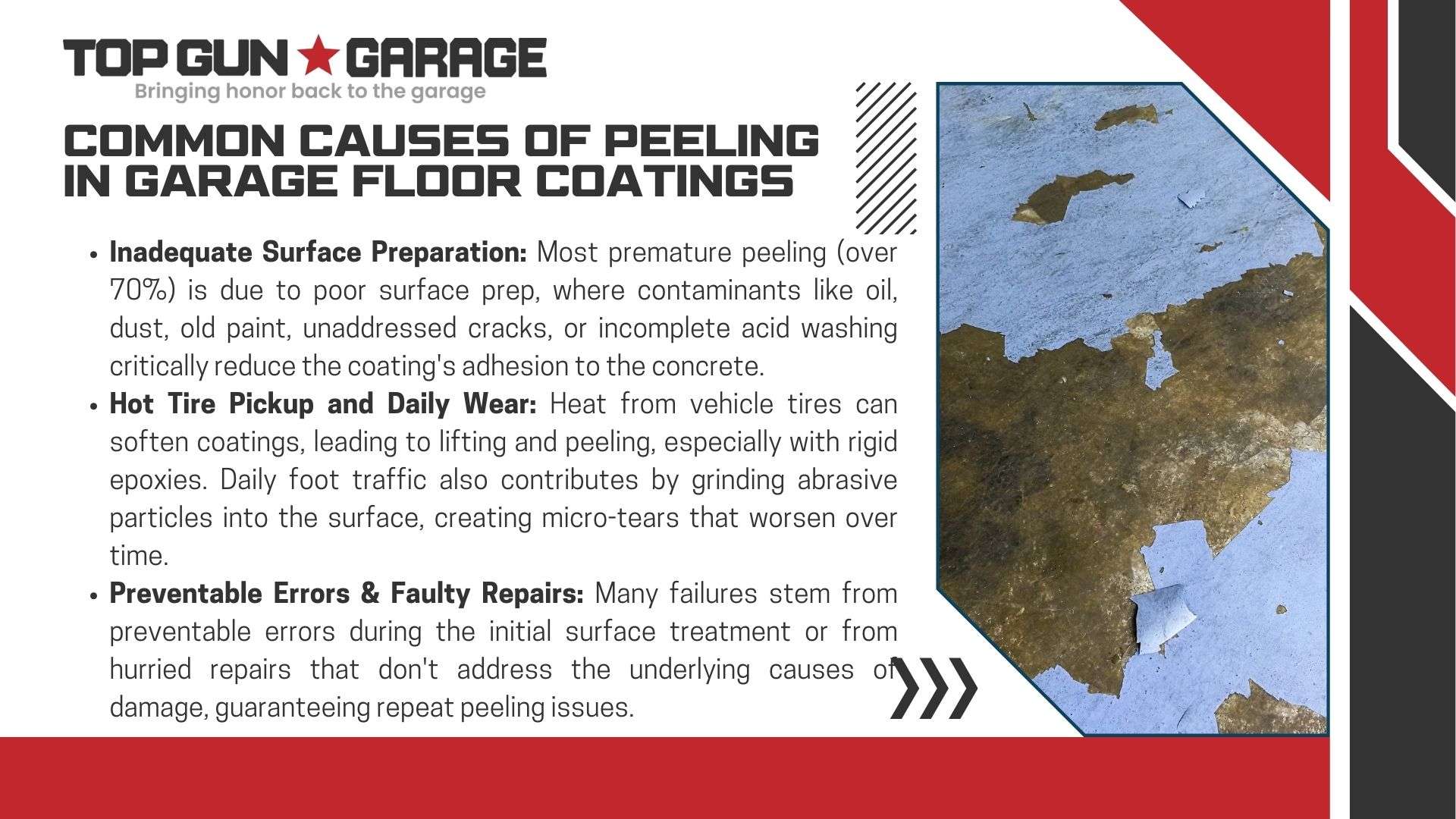 Understanding why protective layers fail requires examining installation practices and environmental stressors. Over 70% of premature coating breakdowns stem from preventable errors during surface treatment, according to industry surveys.
 Vehicle tires transfer heat exceeding 140°F during summer months, softening materials at contact points. This thermal stress causes gradual lifting at edges, particularly with rigid epoxy products. Foot traffic grinds abrasive particles into surfaces, creating micro-tears that expand over time.
Top Gun Garage technicians note recurring cracks often trace back to hurried repairs. “Filling gaps without addressing root causes guarantees repeat failures,” their team emphasizes. Proper garage floor cracks are repaired before epoxy application to ensure lasting results.
Vehicle tires transfer heat exceeding 140°F during summer months, softening materials at contact points. This thermal stress causes gradual lifting at edges, particularly with rigid epoxy products. Foot traffic grinds abrasive particles into surfaces, creating micro-tears that expand over time.
Top Gun Garage technicians note recurring cracks often trace back to hurried repairs. “Filling gaps without addressing root causes guarantees repeat failures,” their team emphasizes. Proper garage floor cracks are repaired before epoxy application to ensure lasting results.
 Proper groundwork determines whether protective finishes stick or fail. A 2023 industry report found 82% of adhesion issues trace back to rushed or incomplete prep work. Three critical steps create surfaces ready for lasting applications.