 Skip to content



Key Takeaways
- Coastal humidity directly impacts adhesion quality for floor coatings
- Professional installers monitor real-time weather data during projects
- Climate-controlled environments prevent moisture-related defects
- Top Gun Garage uses specialized equipment for humidity management
- Curing times vary based on atmospheric conditions
Understanding the Role of Moisture in Epoxy Installation
Environmental conditions during application directly determine coating durability. Two factors dominate this equation: airborne water content and substrate vapor levels. Both influence adhesion strength and visual outcomes.Defining Humidity and Moisture
Humidity measures water vapor suspended in air, expressed as a percentage. Moisture vapor refers to invisible water molecules rising from concrete surfaces. When these elements exceed safe thresholds, they disrupt resin bonding. Top Gun Garage technicians use digital hygrometers to track both metrics, ensuring readings stay below 65% during projects.Common Moisture-Related Issues
Excess ambient dampness causes resin mixtures to trap air, forming permanent bubbles. Temperature swings accelerate or delay curing times, creating uneven textures. A 2022 case study revealed coastal properties with uncontrolled humidity developed cloudy finishes within six months. The firm’s climate-controlled equipment and timed application protocols counteract these risks, adapting to Southwest Florida’s unpredictable weather patterns. Proper surface preparation remains critical. Contaminants like salt or dust amplify vapor emissions, weakening adhesion. By combining industrial dehumidifiers with diamond grinding techniques, installers achieve optimal results even during rainy seasons.How Moisture Affects Epoxy Installation Naples
Epoxy resins transform from liquid to solid through crosslinking—a chemical process sensitive to ambient conditions. In coastal regions, elevated humidity disrupts molecular bonding, creating imperfections. A 2023 study of 50 Florida properties found installations exposed to >70% humidity developed defects 3x faster than controlled environments.Critical Factors During Solidification
Uncontrolled water vapor causes two primary issues. First, amine blush forms a waxy layer when moisture interacts with curing agents. This residue weakens adhesion for subsequent coats. Second, trapped humidity creates microbubbles that expand during temperature spikes, causing delamination.| Issue | Description | Prevention |
|---|---|---|
| Amine Blush | Surface contamination blocking layer bonding | Climate-controlled application zones |
| Incomplete Curing | Soft spots from interrupted crosslinking | Real-time humidity monitoring |
| Delamination | Coating separation due to vapor pressure | Vapor barrier primers |
Environmental Factors Influencing Epoxy Curing
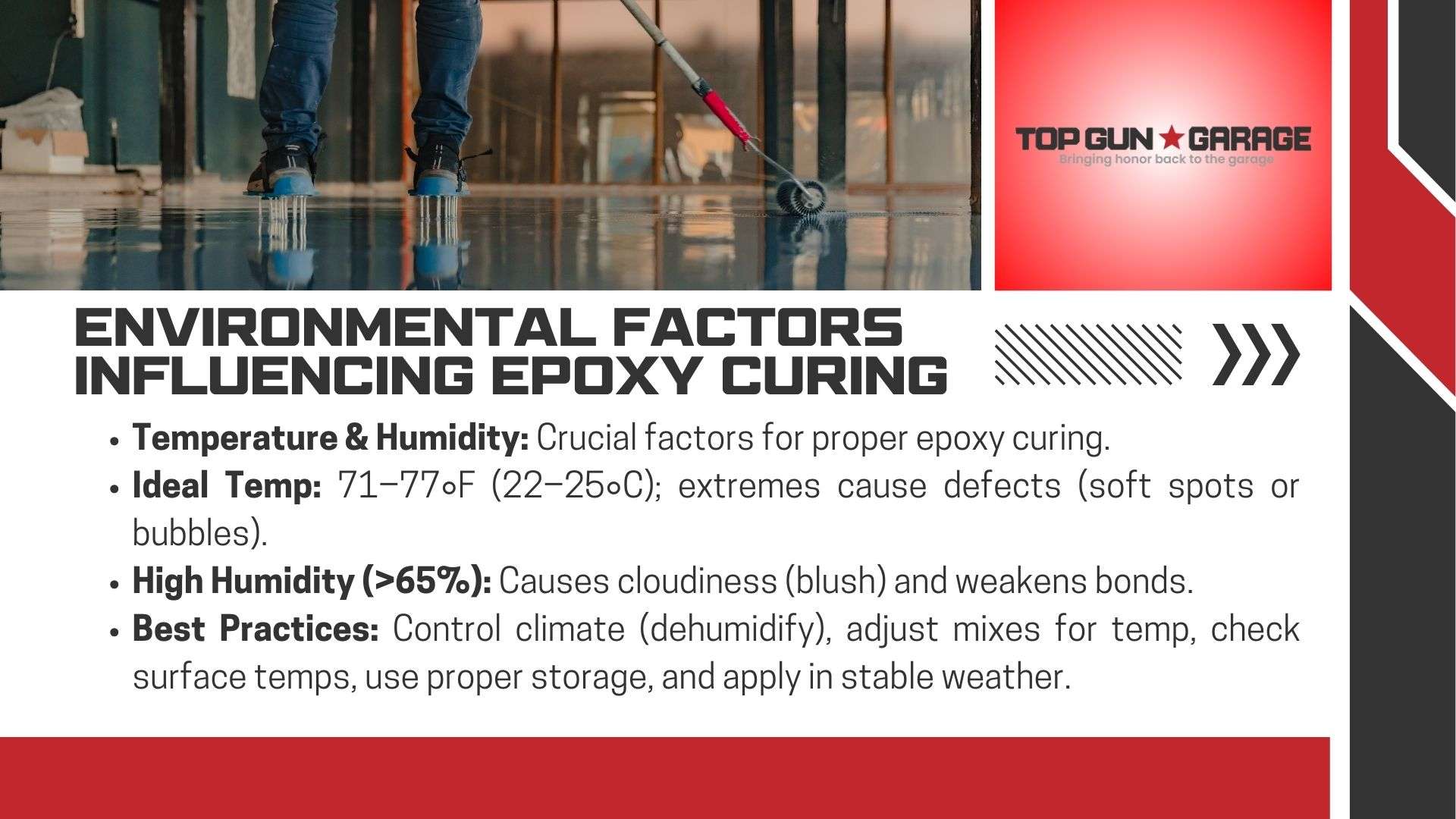 Successful resin applications depend on balancing two invisible forces: heat and airborne water. Even minor fluctuations in these elements alter chemical reactions during solidification. Professional installers prioritize environmental control to achieve durable, visually flawless surfaces.
Temperature Considerations and Its Effects
Heat accelerates molecular activity in resin blends. Ideal curing occurs between 71-77°F (22-25°C). Below this range, crosslinking slows, creating soft spots. Excessive heat causes rapid expansion, trapping air bubbles that weaken structural integrity. Top Gun Garage monitors real-time weather data to adjust material ratios. Cold mornings might require additive-rich mixtures, while afternoon heat demands rapid-set formulas. This precision prevents temperature-induced defects common in Southwest Florida’s variable climate.Air Humidity and Its Role in Epoxy Performance
Humidity above 65% introduces water molecules into uncured resin. These particles react with amines, creating a cloudy film called blush. Left unchecked, this residue compromises interlayer bonding. Advanced climate control systems combat this challenge. Industrial dehumidifiers maintain optimal moisture content during application. Combined with thorough surface preparation, these measures ensure uniform texture and adhesion—even during rainy seasons.- Use infrared thermometers to verify substrate temperatures
- Store materials in climate-controlled spaces before mixing
- Schedule applications during stable weather windows
Preventing Moisture-Related Epoxy Installation Problems
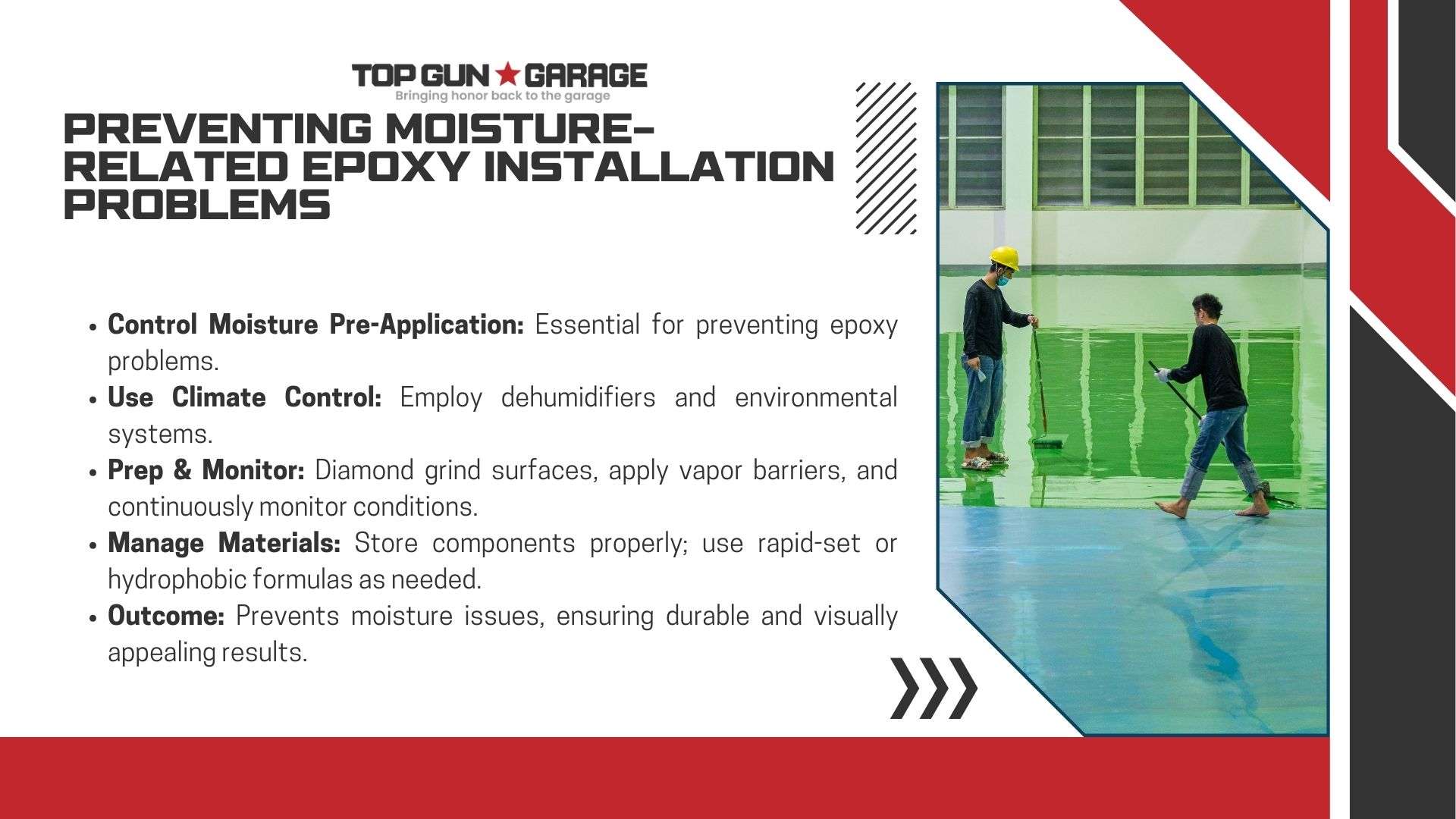 Creating resilient surfaces starts with controlling environmental variables before application. Top Gun Garage prioritizes strategic planning to combat water vapor challenges, ensuring flawless results for coastal properties. Their approach combines advanced technology with meticulous preparation.
Establishing a Dry and Controlled Environment
Industrial dehumidifiers and climate control systems form the foundation of successful resin applications. During a 2023 beachfront garage project, technicians maintained 55% humidity levels using portable drying equipment. This prevented vapor interference during the curing process. Surface preparation techniques include:- Diamond grinding to remove contaminants
- Applying vapor barrier primers
- 24-hour climate monitoring before coating
Techniques for Ensuring Optimal Epoxy Performance
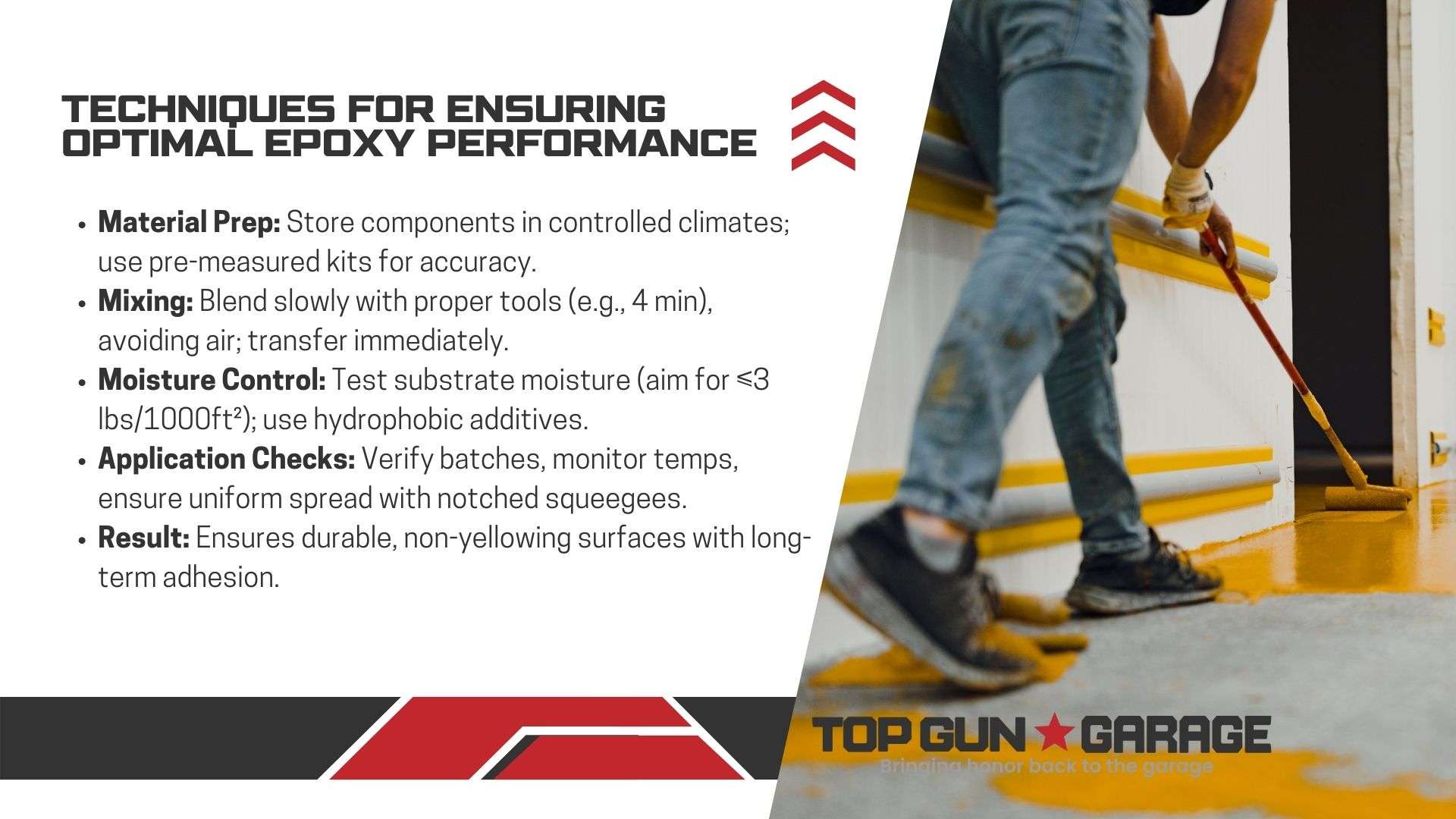 Flawless resin surfaces demand precision from initial preparation to final application. Every step influences durability, especially in environments where vapor emissions challenge material integrity.
Proper Material Preparation and Mixing Techniques
Contamination prevention starts before opening containers. Professionals store components in climate-controlled staging areas to avoid condensation absorption. Pre-measured kits with 2:1 resin-to-hardener ratios eliminate guesswork, ensuring consistent chemical reactions. Mixing errors account for 38% of coating failures according to 2023 industry data. Installers use slow-speed drills with paddle attachments, blending materials for exactly 4 minutes. This prevents air entrapment while achieving complete homogenization. Immediate transfer to application tools avoids premature curing in mixing buckets. Water intrusion—even minor humidity—disrupts crosslinking. Top Gun Garage technicians test concrete substrates with calcium chloride kits, allowing only ≤3 lbs/1000ft² vapor transmission. Hydrophobic additives in premium resins create molecular barriers against residual dampness. Critical quality checks include:- Verifying batch numbers for formula compatibility
- Monitoring ambient temperatures during pour windows
- Using notched squeegees for uniform thickness
Case Studies and Practical Tips for Epoxy Installations
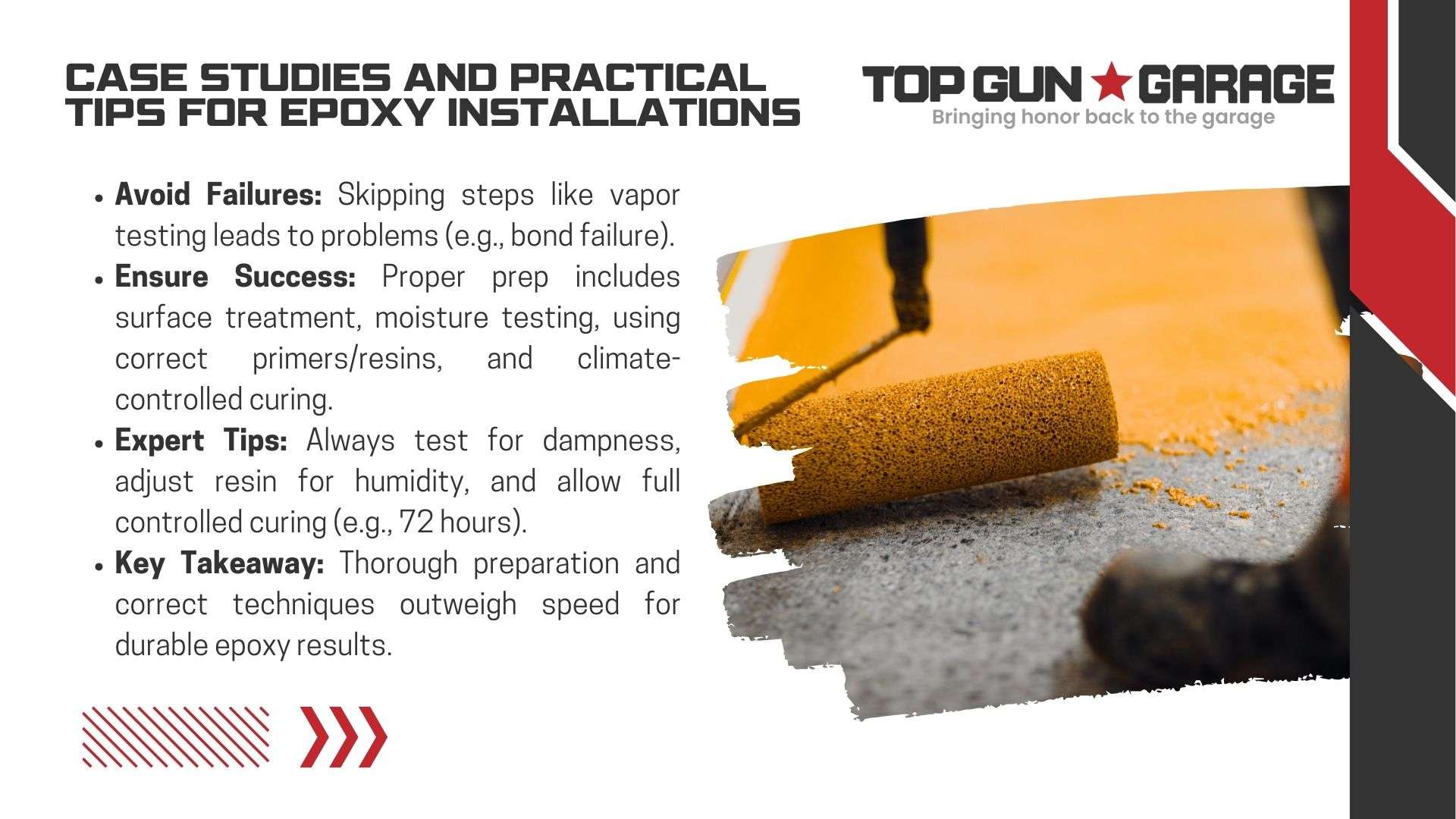 Real-world examples reveal the dramatic difference between proper techniques and overlooked details. In Southwest Florida’s demanding climate, every decision impacts a coating’s lifespan.
Real-Life Scenarios from Naples, FL
A 2022 beachfront condo project highlights risks. Contractors skipped vapor testing before applying standard resin. Within months, air pockets formed beneath the coating, causing bond failure. Top Gun Garage restored the floors using moisture-resistant primers and climate-controlled curing—solving issues permanently. Conversely, a historic Naples home achieved flawless results. Technicians:- Pre-treated concrete with diamond grinding
- Monitored air quality during application
- Used rapid-cure formulas before afternoon storms
Lessons Learned from Industry Experts
Seasoned installers emphasize three rules for durable floors:- Test substrates for hidden dampness
- Adjust resin ratios based on real-time humidity
- Allow 72-hour curing in climate-controlled spaces
Choosing the Right Epoxy Products for Your Project
Selecting suitable materials determines whether floors withstand daily wear or require frequent repairs. High-traffic areas demand different formulations than decorative spaces. Top Gun Garage evaluates each project’s needs through site assessments and climate analysis. Three factors guide product selection in humid environments:| Product Type | Best Use Areas | Moisture Resistance | Maintenance Needs |
|---|---|---|---|
| 100% Solids Epoxy | Garages, workshops | Blocks vapor emissions | Annual cleaning |
| Water-Based Resin | Indoor living spaces | Moderate protection | Biweekly mopping |
| Quartz-Filled Blend | Pool decks, patios | Superior water repellency | Quarterly inspections |
Expert Insights from Top Gun Garage in Naples, FL
Maintaining pristine resin floors in coastal regions requires specialized knowledge of regional challenges. Top Gun Garage’s 19 years of local experience reveal critical patterns influencing floor performance. Their team combines scientific analysis with practical solutions tailored to Southwest Florida’s environment.Utilizing Local Expertise and Best Practices
Three key factors determine floor longevity in humid climates. Surface preparation quality directly impacts adhesion strength. Curing hours must align with real-time atmospheric conditions. Material selection balances aesthetics with vapor resistance.| Factor | Challenge | Solution | Outcome |
|---|---|---|---|
| Climate | High humidity accelerates delamination | Moisture-resistant primers | 10+ year durability |
| Appearance | Cloudy finishes from amine blush | Controlled curing environments | Gloss retention |
| Time | Rushed applications trap moisture | 72-hour curing protocol | Zero bubble formation |
- Schedule installations during stable weather windows
- Verify installer climate control capabilities
- Request hydrophobic additives for pool areas
Conclusion
Achieving durable resin surfaces in coastal areas demands more than quality materials—it requires strategic environmental management. The chemical reaction during curing depends on controlled conditions to prevent defects like bubbling or delamination. Professionals address these challenges through proven methods: climate monitoring, vapor barriers, and tailored material ratios. Property owners have multiple options to ensure success. Advanced dehumidification systems combat airborne dampness, while specialized primers block subsurface vapor emissions. These techniques, combined with precise application timing, neutralize the effects of humidity on curing processes. Top Gun Garage solves concrete dusting problems permanently through science-backed strategies. Their team adapts to Southwest Florida’s climate, offering solutions that balance aesthetics with resilience. From surface preparation to final inspection, every step prioritizes long-term performance. For surfaces that withstand coastal conditions, trust local expertise. Contact Top Gun Garage at (239) 488-7000 to explore options tailored to your project’s needs. Their commitment to precision ensures flawless results—the right way to protect your investment.FAQ
How does humidity impact epoxy curing in Naples?
High humidity slows the curing process by trapping vapor beneath the surface. This leads to uneven textures, bubbles, or weakened bonds. Ideal humidity levels for epoxy resin should stay below 65% during application to ensure proper adhesion and durability.
What temperature range is best for epoxy floor installations?
Epoxy coatings perform optimally between 70°F and 85°F. Temperatures outside this range alter curing times, risking incomplete hardening or surface defects. In Naples’ subtropical climate, early morning or evening applications often yield better results.
Can epoxy coatings adhere to damp concrete surfaces?
Moisture trapped in concrete creates vapor pressure, causing delamination or blistering. Professionals use moisture testing to test slabs before installation. Solutions like vapor barriers or moisture-tolerant products prevent long-term failure in humid environments.
How do contractors prevent bubbles during epoxy mixing?
Proper material preparation includes slow, consistent stirring to minimize air entrapment. Using additives like anti-foaming agents and allowing mixed resin to rest before application reduces bubble formation. Climate-controlled spaces further enhance finish quality.
Why choose Top Gun Garage for Naples epoxy projects?
Local expertise matters. Top Gun Garage understands Naples’ unique climate challenges, from seasonal humidity spikes to salt air exposure. Their team employs advanced techniques like moisture vapor barrier systems and UV-resistant coatings tailored for coastal conditions.
What maintenance extends epoxy flooring lifespan?
Regular cleaning with pH-neutral cleaners preserves the glossy finish. Avoid abrasive tools or harsh chemicals. Reapplying a topcoat every 2-3 years refreshes protection, especially in high-traffic areas like garages or commercial spaces.
Are there epoxy options for high-moisture environments?
Moisture-tolerant epoxies or industrial-grade polyaspartic vs epoxy coatings resist vapor transmission. These products bond effectively even when relative humidity exceeds 75%, making them ideal for Florida’s coastal regions.
How long should concrete cure before epoxy application?
Fresh concrete requires 28 days to fully cure and release excess water. For existing slabs, moisture content must test below 4.5% using ASTM F1869 standards. Rushing this step risks epoxy adhesion failure and costly repairs.