



The problem is that coating names do not tell you everything you need to know.
The right concrete floor coating system depends on the concrete underneath it, where the floor is located, how much sunlight reaches it, how slippery it may become when wet, and what the room actually needs to handle. Before choosing a product, start with the space.
Epoxy Floor Coatings
Epoxy remains one of the best-known resin flooring materials.
It can create a strong bond to properly prepared concrete and works well as part of many residential, commercial, and industrial coating systems. Epoxy also provides excellent design flexibility.
It can be used beneath decorative flakes, as a solid-color floor, within metallic systems, or as part of a multi-layer coating build. However, not all epoxy is identical.
Different formulations have different cure times, thicknesses, chemical resistance, working times, and moisture limitations. Epoxy also performs better when protected from prolonged ultraviolet exposure.
That makes it especially useful for interior areas or as a base layer beneath a UV-stable topcoat. The important question is not simply whether a contractor uses epoxy.
Ask where it appears in the system and what is installed above and below it.
Polyaspartic Floor Coatings
Polyaspartic coatings are commonly used where faster curing and strong UV resistance are valuable.
They can work well as topcoats over decorative flake flooring because they provide a clear protective layer while resisting yellowing from sunlight better than many traditional epoxy formulations.
Fast cure time can also reduce downtime. Faster is not automatically better in every layer of every system.
A rapidly curing product gives less working time. Concrete temperature, humidity, slab condition, and application technique become important. The chemistry touching the concrete also deserves attention.
Some floors benefit from a dedicated primer or epoxy base before a polyaspartic topcoat is installed.
That is why buyers should be cautious when every project is sold with the same simple promise of polyaspartic directly over concrete. System design matters more than the marketing label.
Epoxy Versus Polyaspartic
People ask which material is better. That question assumes you have to choose one. Many professional flooring systems use different products in different layers because each layer has a separate job.
For example, a system might use a base coat designed for adhesion to prepare concrete, decorative flakes for appearance and texture, then a polyaspartic topcoat for UV stability and surface protection.
Another project may require a completely different build.
Rather than asking epoxy versus polyaspartic, ask these questions.
- What material bonds directly to my concrete?
- Why was that material selected?
- What provides the decorative finish?
- What protects the surface?
- How does the system handle the exposure in this particular room?
Those answers reveal much more about the floor than a single coating name.
Decorative Flake Floor Systems
Flake systems are popular for garages because they combine appearance with practical surface texture.
Decorative chips are broadcast into a wet base coat. Depending on the system, they may be applied lightly or broadcast heavily until the base is covered.
Excess material is removed after curing, and a protective clear coat goes over the surface.
- Flakes do several things.
- They add color variation.
- They help disguise minor dirt and everyday marks.
- They create texture.
They also allow homeowners to coordinate the floor with walls, cabinetry, exterior finishes, and nearby surfaces. However, pattern matters.
A very busy blend can hide small debris or dropped items. A dark blend may show pale dust differently from a light floor. Large flakes can create a stronger visual pattern than smaller ones.
The right blend should work with the room rather than simply looking impressive on a small sample board.
Solid-Color Concrete Coatings
Solid-color floors create a cleaner and more uniform appearance.
Instead of decorative chips breaking up the surface, one primary color extends across the room.
This can work particularly well in minimalist interiors, commercial spaces, work areas, or properties where a simple architectural finish is preferred. However, solid colors can reveal more.
Dust may stand out strongly against very dark floors. Scratches, dirt, surface marks, and small variations can also become easier to notice because there is no flake pattern helping disguise them.
Sheen changes that affect further. High gloss reflects more light and can make the floor visually dramatic, but it may also reveal dust and streaking under strong lighting.
A solid-color floor can look excellent when the room and maintenance expectations suit it.
What About Metallic Epoxy
Metallic epoxy creates movement and depth rather than a uniform flake pattern. Pigments are manipulated within the coating to create swirls, variations, and changing visual effects across the floor.
Each installation develops its own appearance.
Metallic flooring can work well in showrooms, entertainment rooms, retail environments, interior residential spaces, and other areas where design carries significant importance.
However, buyers should understand what they are choosing. Metallic floors are intentionally variable.
A small sample cannot reproduce exactly what a full room will look like.
Lighting also changes the effect dramatically. Directional LEDs, windows, daylight, and gloss can make portions of the floor appear different as you move through the space.
It is a design-focused system rather than the automatic answer for every concrete floor.
Surface Preparation Comes Before Coating Choice
This is the part buyers should care about most.
Even an expensive coating can fail when the concrete underneath was poorly prepared.
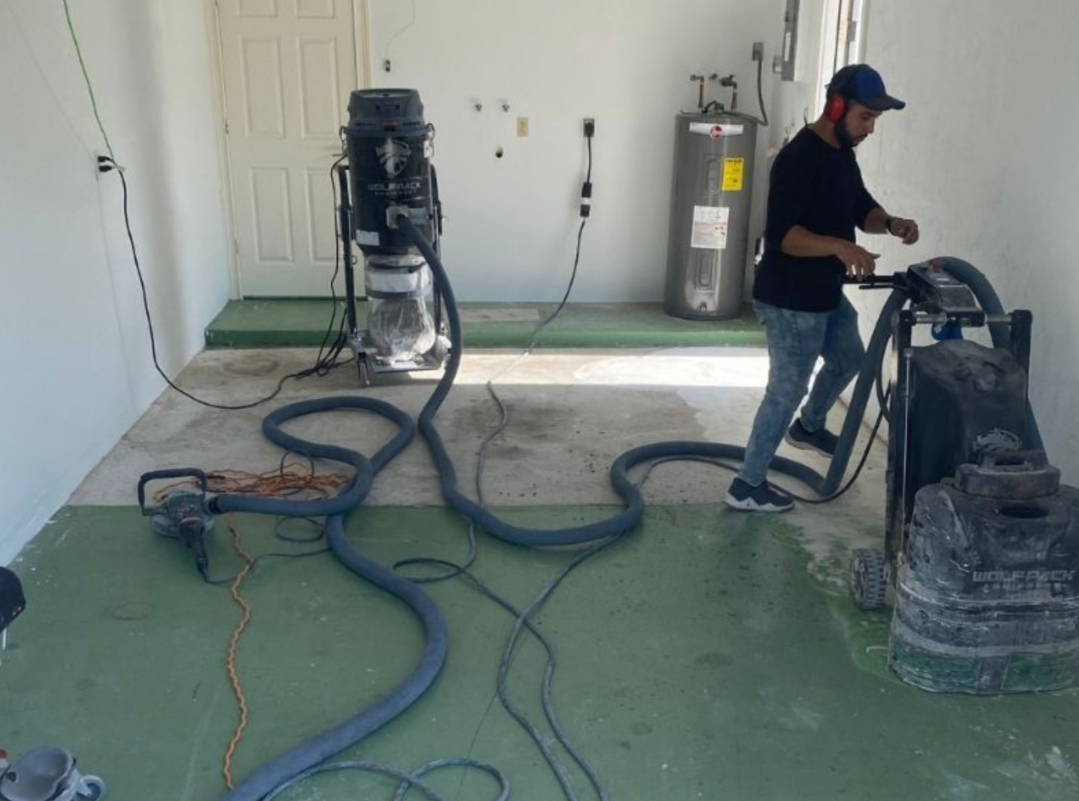
Professional concrete floor coating installation normally starts by mechanically preparing the slab.
Diamond grinding is commonly used to remove weak surface material and create a suitable profile for coating adhesion. Existing paint or coatings may need removal.
Cracks and damaged areas may need repair. Oil contamination can require additional treatment.
Adhesive residue from previous flooring needs attention. Moisture conditions can change the primer or coating specification. The finished system starts before the first coating container is opened.
When comparing epoxy flooring contractors, ask how the concrete will be prepared before asking which decorative flake color they offer.
Moisture Can Change the Entire System
Concrete can appear completely dry while still transmitting moisture vapor.
That matters when a relatively impermeable coating is installed over the slab. Excessive moisture can contribute to bubbling, blistering, adhesion loss, or other failures underneath the coating.
Certain floors may therefore require moisture testing or additional mitigation.
A primer designed for the slab condition may also become part of the system.
This is another reason one coating package should not automatically be installed on every property.
The concrete helps determine what belongs above it.
Direct Sunlight Changes Product Selection
UV exposure matters most near exterior openings and on outdoor concrete.
Traditional epoxy can discolor or amber when exposed to sustained ultraviolet light.
That does not automatically remove epoxy from the system. An epoxy base protected beneath flakes and a more UV-stable topcoat may still work well in many applications.
Exterior patios, pool decks, driveways, and garage threshold areas need greater attention to sunlight.
Polyaspartic and other UV-stable finish materials can be valuable in those environments.
Ask the contractor which layer receives direct sunlight and why that chemistry was selected.
That answer is more meaningful than simply asking if the coating is UV resistant.
Traction Should Match the Room
A perfectly smooth floor can look attractive. Add water and the situation can change.
Garages, pool decks, patios, commercial kitchens, breweries, bathrooms, and other wet environments need traction considered during system design.
Texture can come from decorative flakes, aggregates, additives, or the finished surface profile.
More texture does not automatically mean better flooring. An extremely aggressive finish may become difficult to mop or wipe. It may also trap dirt more readily.
Pool decks need barefoot comfort. Commercial kitchens need dependable footing during wet work. Garages need a reasonable balance between cleanup and traction.
The right texture depends on how the room gets wet and how it gets cleaned.
UV Exposure & Traction Work Together Outdoors
Outdoor flooring adds another layer of complexity. A pool deck needs UV stability, wet traction, drainage awareness, and barefoot comfort. A patio needs to handle sunlight while remaining practical under furniture. A driveway is exposed continuously instead of occasionally.
These spaces should not automatically receive the same system installed inside a protected garage. Exterior concrete also experiences more environmental exposure before installation.
Existing sealers, dirt, weathering, cracks, and surface contamination may need attention during preparation. The environment should influence both chemistry and texture.
Choose a Garage Coating Around the Garage
Garage floor coatings are commonly sold as standardized packages. The slab may not be standard. One garage has clean, newer concrete. Another has old paint. Another contains oil contamination. Another shows moisture problems. Another receives strong afternoon sunlight through the door.
Those differences matter. A decorative flake system with a suitable primer or base coat and a quality protective topcoat can work extremely well for many garages.
The exact layers should respond to the slab. Color and sheen should also fit the room. Bright lighting, white walls, dark cabinetry, limited floor area, and storage density can all change which finish looks best.
Choose Interior Coatings Around Appearance and Cleaning
Interior concrete provides more freedom because UV exposure may be limited.
Kitchens, bathrooms, man caves, offices, retail spaces, and showrooms can use coating design more aggressively when the environment allows it. Solid colors may fit modern interiors.
Metallic floors can create stronger visual character. Flake systems can provide pattern and practical texture. Still, interior spaces have their own demands. Bathrooms need wet traction.
Kitchens need easy cleanup. Offices need finishes that work around furniture and lighting. Showrooms need controlled reflection. The coating should solve the room rather than simply decorate it.
You can review examples of completed systems through the Top Gun Garage Past Work gallery and compare available applications through the Top Gun Garage Services page.
FAQs About Choosing Concrete Floor Coatings
1. Is epoxy or polyaspartic better for a garage floor?
Both can play valuable roles. Epoxy can provide an effective base layer, while polyaspartic is commonly used where faster curing and better UV stability are useful. The full system matters more than choosing one name.
2. Are flake floors more durable than solid-color coatings?
The decorative flakes themselves do not determine durability. Preparation, base coat, coating thickness, topcoat, substrate condition, and use have greater influence on performance.
3. Do outdoor concrete coatings need UV protection?
Yes. Exterior surfaces and areas receiving direct sunlight need coating chemistry suited to UV exposure. Some resin materials resist color changes from sunlight better than others.
4. How much texture should a concrete floor coating have?
Enough for the expected wet conditions without making normal cleaning unnecessarily difficult. Pool areas, commercial kitchens, and dry interior rooms may each need different texture levels.
5. What is the most important part of a floor coating system?
Proper concrete preparation is one of the most important factors. Even quality coating materials can perform poorly when installed over weak, contaminated, or improperly prepared concrete.
Choose the System Instead of the Product Name
Epoxy is not automatically the answer. Neither is polyaspartic. Flake flooring is not automatically better than solid color, and the fastest installation is not automatically the strongest choice.
The right system begins with the concrete, then considers room use, moisture, UV exposure, traction, appearance, cleaning, and downtime. Top Gun Garage approaches concrete flooring that way.
Rather than forcing the same package onto every slab, the better starting point is understanding what the property actually needs from the finished floor.