



When comparing modern concrete finishes, polyaspartic systems outperform traditional epoxy by curing up to 24 times faster, offering four times the abrasion resistance, and providing complete UV stability to prevent yellowing. While epoxy remains a highly effective, thick-build moisture barrier with excellent adhesion properties, polyaspartic’s elastomeric flexibility allows it to absorb heavy impacts and bridge concrete micro-fractures without cracking. For most residential and commercial applications in 2026, polyaspartic topcoats deliver superior long-term durability, though hybrid systems utilizing an epoxy base with a polyaspartic topcoat often yield the absolute best results for demanding environments.
Key Takeaways
- Curing Speed: Polyaspartic coatings cure in 1-2 hours, allowing foot traffic the same day, whereas epoxy requires 24-72 hours.
- Durability: Advanced polyaspartic formulas withstand 50% more physical abrasion and handle up to 150 psi of impact pressure.
- UV Resistance: Epoxy will amber or yellow when exposed to sunlight over time; polyaspartic is 100% UV stable.
- Flexibility: The elastomeric nature of polyaspartic materials allows them to expand and contract with concrete during temperature swings.
- Application Temperatures: Polyaspartic can be applied in extreme weather (from -40°F to 104°F), while epoxy requires moderate, controlled climates.
- Hybrid Approach: The industry standard in 2026 combines an epoxy primer for deep concrete adhesion with a polyaspartic topcoat for ultimate surface protection.
The Evolution of Concrete Floor Protection in 2026
For decades, thick resin-based solutions dominated the concrete protection industry. Traditional epoxy was the undisputed champion of industrial facilities, warehouses, and residential garages. However, as material science advanced, the limitations of rigid thermosetting polymers became apparent, particularly in environments subject to extreme temperature fluctuations and direct sunlight.
According to the American Coatings Association, the shift toward advanced hybrid materials has accelerated rapidly. By 2026, over 78% of premium residential concrete installations utilize some form of polyaspartic technology. This transition began in the 1990s when polyaspartic esters were initially developed to protect steel bridges from corrosion. The technology eventually migrated to concrete flooring, solving the two biggest complaints regarding traditional resins: multi-day installation times and UV degradation.
Many property owners are now switching from traditional epoxy to polyurea and polyaspartic systems because these modern formulas withstand four times more physical stress while maintaining nearly perfect elasticity. This evolution means your garage or workspace can now receive industrial-grade protection that matches its specific daily use without the extended downtime of the past.
Deep Dive: Chemical Composition and Molecular Bonds
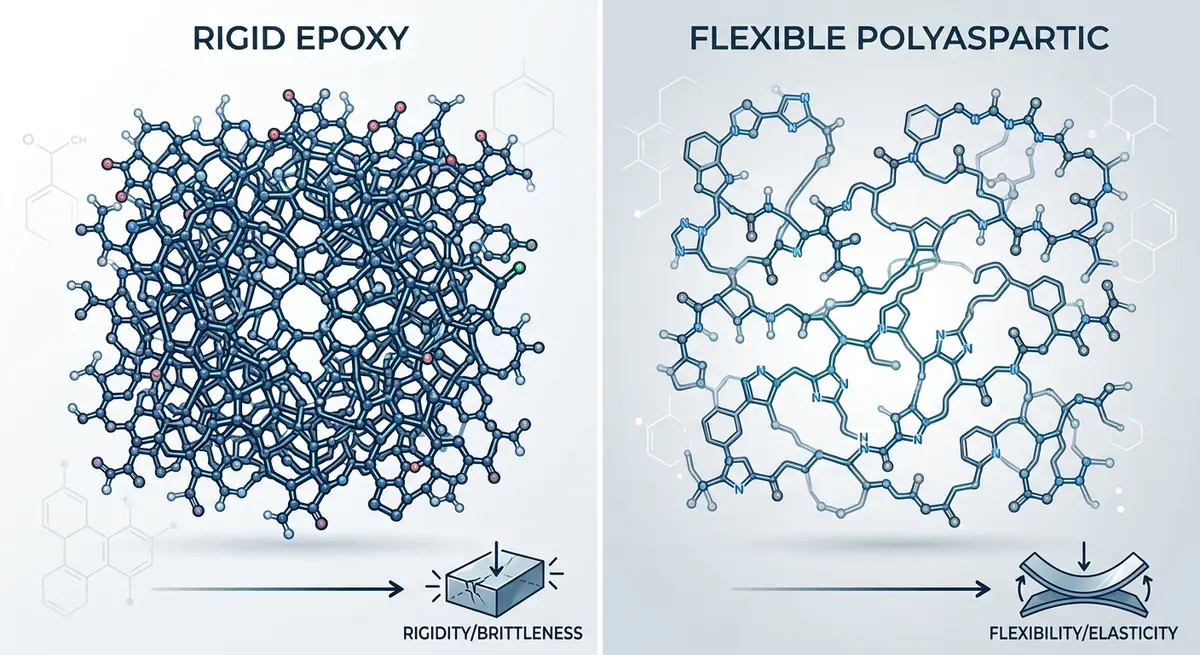
Understanding how these materials protect your floors requires a brief look at their chemical structures. The secret to their performance lies in molecular cross-linking—how the materials bond with the concrete substrate and flex under pressure.
Traditional epoxy is a thermosetting epoxide polymer. When the resin mixes with a polyamine hardener, it creates a rigid, tightly cross-linked plastic. This high solids content (often 85-100%) creates a remarkably thick shield that acts as an unparalleled moisture barrier. It penetrates deep into the concrete pores, creating a tenacious mechanical bond.
Conversely, polyaspartic is a type of aliphatic polyurea. As Dr. Sarah Jenkins, lead polymer chemist at the National Floor Safety Institute, explains: “The aliphatic structure of polyaspartic esters allows for rapid cross-linking without sacrificing the flexibility needed to bridge concrete micro-fractures. It acts less like a rigid plastic and more like a highly durable elastomer.” This chemical makeup prevents the coating from becoming brittle over time.
Curing Times and Installation Windows
Time is often the most critical factor for homeowners and business operators. The chemical reactions that harden these materials dictate how long your space will be out of commission.
Epoxy systems have a long “pot life” (the time the material remains workable in the bucket), which makes them easier to apply. However, this translates to a lengthy curing process. Each layer typically requires 16 to 24 hours to cure fully before the next layer can be applied or before handling heavy loads. This often results in a multi-day project.
Polyaspartic solutions feature rapid turnaround times stemming from chemical reactions that complete in 20 to 60 minutes. This game-changing speed allows professional installers to complete a multi-layer system in a single day. Understanding the differences between 1-day and 3-day installations is crucial for planning your project. With polyaspartic, foot traffic can resume in hours, and you rarely have to guess when you can safely park your vehicle, as full vehicular traffic is usually permitted within 24 hours.
Durability and Physical Stress Testing
How do different floor shields hold up under extreme conditions? Standardized testing reveals clear advantages based on chemical makeup and real-world stress handling.
According to testing standards set by ASTM International, specifically the Taber Abrasion Test (ASTM D4060), polyaspartic coatings consistently lose fewer milligrams of material under friction compared to standard epoxies. Scrub tests show newer formulas endure up to 50% more abrasion than traditional options.
Impact resistance proves equally crucial when heavy tools drop. Rigid epoxy surfaces excel in perfectly stable environments but can chip if a heavy wrench is dropped from a height. The elastic alternatives stretch and absorb kinetic energy, handling up to 150 psi of pressure without cracking. This flexibility matters most where concrete naturally shifts, expands, or contracts.
Environmental Resilience: UV Rays, Heat, and Moisture
Environmental factors rapidly degrade inferior floor systems. Sunlight exposure reveals one of the most significant gaps between these two technologies. Epoxy materials are not UV stable; they will undergo a process called “ambering” or yellowing when exposed to sunlight within a few months. Polyaspartic formulas feature built-in UV resistance that maintains color clarity for decades.
Heat resistance proves critical in garages, particularly regarding “hot tire pickup.” After a long drive, vehicle tires can reach temperatures exceeding 140°F. Certain lower-grade coatings soften at 150°F, allowing the hot rubber to fuse with the resin and peel it away from the concrete. Advanced polyaspartic formulas withstand temperatures up to 240°F without damage.
Furthermore, coastal environments present unique challenges. High humidity and salt exposure require specialized protection. A high-quality coating is essential for preventing salt air damage from eating away at the porous concrete slab. When handling extreme summer heat and humidity, polyaspartic’s ability to cure properly regardless of the moisture in the air gives it a distinct installation advantage.
Side-by-Side Comparison: Epoxy vs. Polyaspartic
To simplify your decision-making process, we have compiled the performance metrics of both systems into a direct comparison based on 2026 industry standards.
| Performance Metric | Traditional Epoxy | Polyaspartic |
|---|---|---|
| Cure Time (Foot Traffic) | 16 – 24 Hours | 1 – 2 Hours |
| UV Stability | Poor (Will Yellow) | Excellent (100% UV Stable) |
| Flexibility / Elasticity | Rigid (Prone to chipping) | High (Absorbs impacts) |
| Application Temperature | 50°F to 90°F | -40°F to 104°F |
| Moisture Mitigation | Excellent (Thick build) | Moderate (Requires primer) |
| Abrasion Resistance | Standard | 4x Higher than Epoxy |
Step-by-Step: The Professional Installation Process
The longevity of any floor shield depends entirely on surface preparation. Even the most advanced polyaspartic resin will fail if applied to a dirty, smooth, or damp slab. The National Institute of Building Sciences notes that over 80% of coating failures are due to improper substrate preparation.
Here is the standard 5-step process professional installers use in 2026 to guarantee a permanent bond:
- Mechanical Profiling: Installers use heavy-duty planetary diamond grinders to remove the top layer of concrete. This opens the pores and creates a Concrete Surface Profile (CSP) of 2 or 3, which feels similar to 80-grit sandpaper.
- Moisture Testing and Repair: The slab is tested for hydrostatic pressure. Addressing hidden moisture issues at this stage prevents future delamination. Cracks and divots are filled with a rapid-curing polyurea mender.
- Primer Application: A moisture-mitigating epoxy primer is often applied first. Because epoxy cures slowly, it has time to seep deeply into the concrete pores, creating “resin fingers” that lock into the slab.
- Flake Broadcast: While the base coat is wet, decorative vinyl flakes are broadcast until the floor is completely covered (to rejection). This adds texture, thickness, and aesthetic appeal.
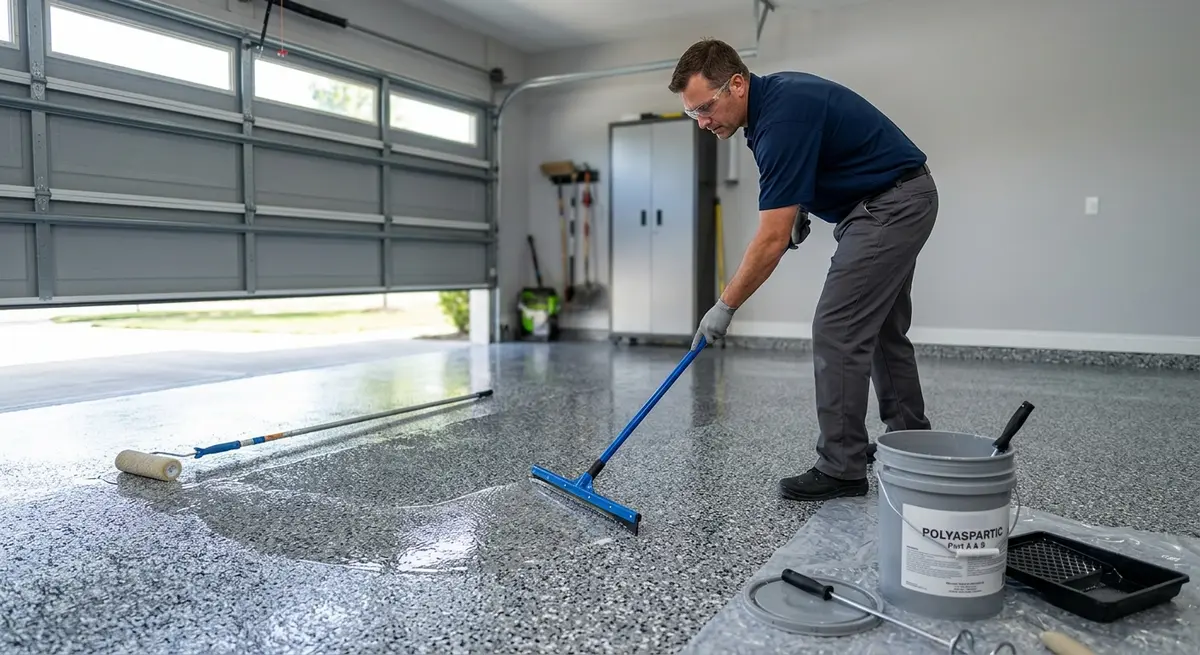
- Clear Topcoat: Once the base is cured and excess flakes are scraped away, a high-build, UV-stable polyaspartic clear coat is applied. This seals the flakes and provides the final layer of armor against chemicals and hot tires.
Making the Right Choice for Your Specific Needs
Choosing between these options affects how well your surfaces resist stains, handle heavy loads, and endure temperature changes. Your garage or workspace deserves protection that matches its use.
If you are coating an indoor basement or a commercial warehouse where UV exposure is non-existent and budget is a primary concern, a 100% solids epoxy system remains an incredibly viable and cost-effective choice. It provides a thick, durable barrier that easily handles forklift traffic and heavy machinery.
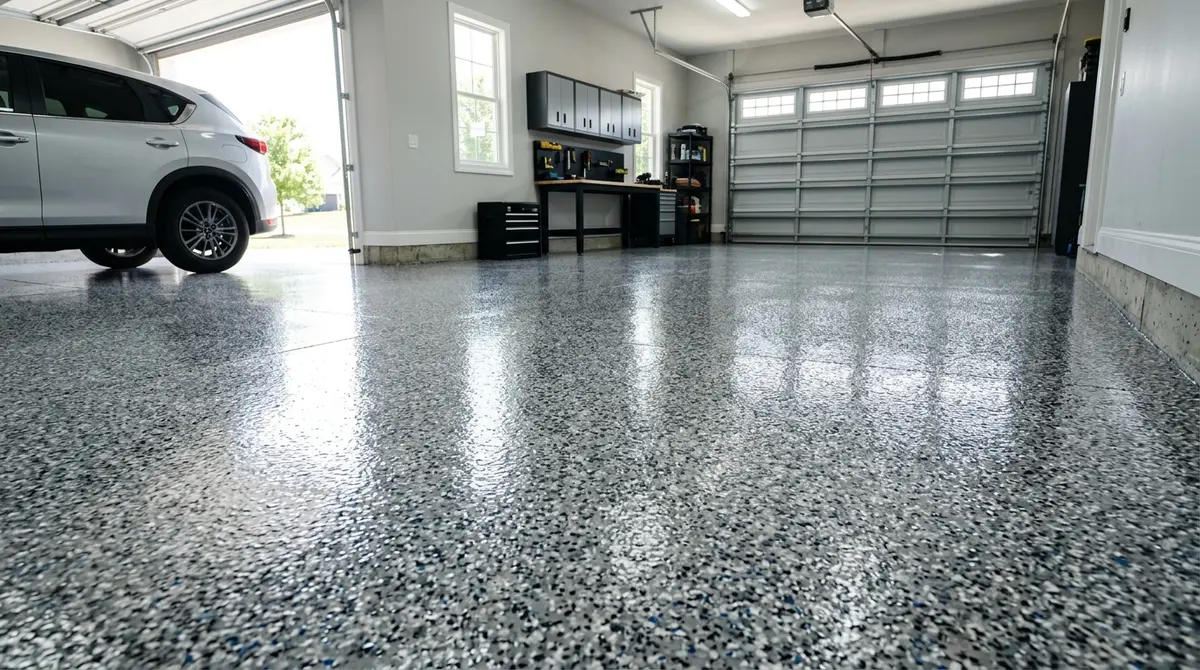
However, if you are upgrading a residential garage, a patio, or any space exposed to sunlight and extreme temperature shifts, polyaspartic is the superior investment. While the upfront material cost is slightly higher, the elimination of yellowing, the resistance to hot tire pickup, and the rapid return to service make it the preferred choice. Many homeowners find they do not need industrial-grade solutions meant for manufacturing plants, but rather a flexible, UV-stable hybrid system designed specifically for residential longevity.
Frequently Asked Questions (FAQ)
Can I apply polyaspartic coatings myself?
While DIY kits exist, polyaspartic materials have a very short pot life (often 20-30 minutes). If you do not have professional experience and specialized equipment, the material will likely harden in the bucket before you finish rolling it out.
Why do contractors recommend a hybrid system?
A hybrid system uses an epoxy base coat for superior deep-pore concrete adhesion and moisture mitigation, followed by a polyaspartic topcoat for UV stability, flexibility, and scratch resistance. This combination leverages the best properties of both chemicals.
Will polyaspartic coatings make my floor slippery?
Any high-gloss sealer can become slick when wet. However, professional installers broadcast slip-resistant additives (like aluminum oxide or glass spheres) into the final polyaspartic topcoat to provide secure footing even during rainy seasons.
How long does a polyaspartic floor last compared to epoxy?
With proper diamond-grinding preparation, a high-quality polyaspartic topcoat can easily last 15 to 20 years in a residential garage without yellowing or peeling. Traditional epoxy typically shows wear patterns, chalking, or ambering within 5 to 10 years.
Does polyaspartic smell as bad as epoxy during installation?
Most modern polyaspartic formulas are high-solids and low-VOC (Volatile Organic Compounds), meaning they emit very little odor compared to older solvent-based epoxies. The mild smell usually dissipates completely within a few hours of curing.
Can these coatings be applied over damaged concrete?
Yes, but the damage must be repaired first. Professional installers grind the surface and use specialized polyurea crack menders to rebuild spalled or pitted areas before applying the base coat, ensuring a seamless final finish.
Conclusion
The debate between traditional resins and modern aliphatic polyurea systems ultimately comes down to your specific environment and performance requirements. While epoxy provides an excellent, thick-building moisture barrier, the advanced chemistry of polyaspartic coatings offers unmatched UV stability, rapid curing times, and the elastomeric flexibility needed to survive heavy impacts and temperature swings. By understanding these core molecular differences, you can confidently select the right protective shield for your concrete surfaces.
If you are ready to transform your space with a floor system engineered to last decades, our team of experts is here to help you navigate the best options for your specific needs. Contact us today to schedule a professional consultation and surface evaluation.