Epoxy flooring Naples FL commercial installations require specialized formulations engineered to withstand forklift traffic, constant foot volume, and the unique challenges of Collier County’s humid subtropical climate. According to the American Concrete Institute, properly specified commercial epoxy systems deliver 15-20 years of service life under heavy traffic conditions, making them the most cost-effective flooring solution for retail stores, warehouses, manufacturing facilities, and automotive dealerships throughout Southwest Florida.
The difference between residential and commercial epoxy systems is substantial. Commercial specifications require thicker build-ups, higher compressive strength ratings, and enhanced chemical resistance. This guide details exactly which systems perform best for different commercial applications in Naples and surrounding areas.
Why Commercial Epoxy Systems Differ From Residential Applications
The fundamental engineering requirements change when floors must support business operations rather than personal vehicles. Commercial environments generate concentrated loads, repetitive stress patterns, and continuous traffic that residential systems cannot handle.
Load-Bearing and Impact Resistance
Commercial spaces face point loads that residential floors never encounter. Forklifts concentrate 5,000-10,000 pounds on contact patches measuring just 4-6 square inches per wheel. Pallet jacks create similar concentrated stresses. According to ASTM C1583 testing standards, commercial epoxy must demonstrate adhesion strength exceeding 350 psi to resist delamination under these conditions.
Impact resistance matters equally. Dropped tools, equipment, and merchandise create stress events residential coatings never experience. Commercial formulations incorporate flexibilizers that absorb impact energy without cracking or chipping.
Abrasion and Wear Resistance
A retail store with 500 customer visits daily generates approximately 180,000 annual foot traffic events. Warehouses with motorized equipment add steel-wheeled pallet jacks, rubber-tired forklifts, and shopping carts creating continuous surface abrasion. The International Concrete Repair Institute (ICRI) rates commercial epoxies using Taber Abrasion testing (ASTM D4060), where acceptable systems lose less than 50 milligrams per 1,000 cycles.
Chemical and Stain Resistance
Commercial environments expose floors to chemicals residential spaces never encounter: hydraulic fluid in warehouses, battery acid in automotive shops, food oils in restaurants, cleaning solutions in medical facilities, and petroleum products in service bays. Professional-grade systems must resist all common industrial chemicals per ASTM D1308 standards without staining, softening, or surface degradation.
Commercial vs. Residential Epoxy System Comparison
The following table illustrates the key specification differences between residential and commercial epoxy applications:
Specification
Residential
Commercial
Film Thickness
8-12 mils
15-40 mils
Compressive Strength
6,000-8,000 psi
10,000-15,000 psi
Abrasion Loss (Taber)
50-100 mg/1000 cycles
<50 mg/1000 cycles
Expected Lifespan
10-15 years
15-20 years
Cost per Sq Ft
$5-$9
$8-$18
Commercial Applications: Matching Systems to Business Needs
Different commercial operations generate distinct wear patterns and performance requirements. Proper system selection begins with understanding your specific traffic and use patterns.
Retail Stores and Shopping Centers
Retail environments prioritize aesthetics alongside durability. Customer-facing areas require floors that enhance brand image while handling constant foot traffic, shopping cart wheels, and merchandise displays. Semi-gloss finishes with decorative flake systems create attractive, slip-resistant surfaces that hide minor wear.
Naples retail establishments serving tourist populations see intensified seasonal traffic. Fifth Avenue South shops and Waterside Shops can experience 300-500% traffic increases during winter months. Epoxy systems rated for 150+ daily foot traffic events per square foot maintain appearance through these surges.
Warehouses and Distribution Centers
Warehouse operations demand maximum durability and minimal downtime. Facilities running 24/7 operations cannot afford extended installation schedules. Fast-cure polyaspartic systems allow return to service within 24 hours compared to 3-5 days for traditional epoxy.
Forklift traffic creates the most severe wear conditions. Solid rubber tires on electric forklifts and pneumatic tires on propane units require different coating responses. High-build epoxy systems (20-40 mils) with polyaspartic topcoats handle both tire types effectively. Learn more about commercial epoxy for loading docks.
Manufacturing and Production Facilities
Manufacturing floors face chemical exposure, thermal cycling, and heavy point loads simultaneously. Machine tool installations can create concentrated loads exceeding 50,000 pounds per support foot. Chemical-resistant epoxy mortars (epoxy mixed with aggregate fillers) provide the mass and thickness needed to distribute these loads safely.
Electronics manufacturing requires static-dissipative flooring that prevents electrostatic discharge (ESD) damage to sensitive components. Conductive epoxy systems incorporating carbon or metal fibers meet ANSI/ESD S20.20 requirements while maintaining chemical and abrasion resistance.
Automotive Dealerships and Service Centers
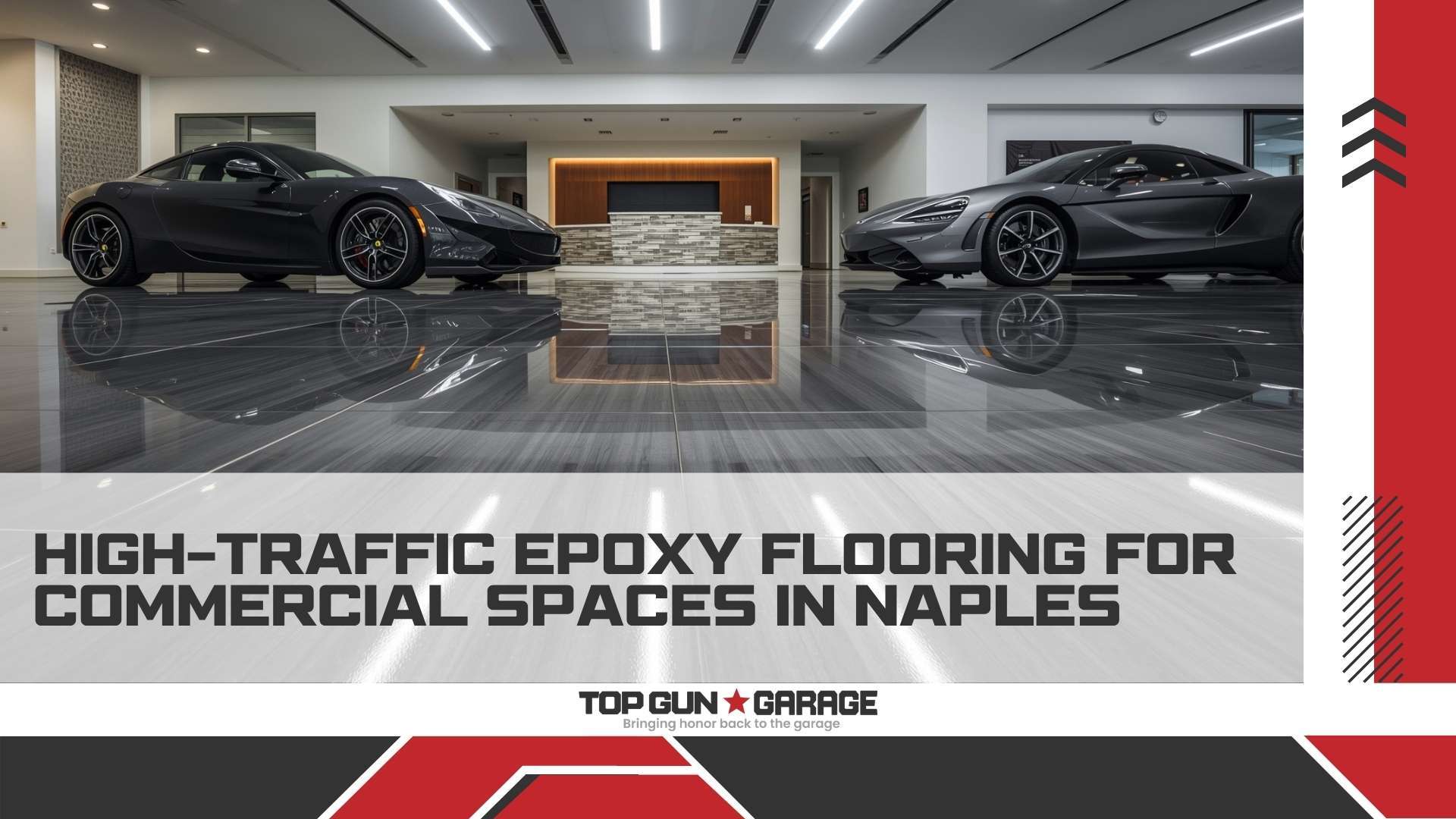
Dealership showrooms demand high-gloss finishes that reflect lighting and enhance vehicle presentation. These aesthetic requirements cannot compromise durability since rotating inventory means constant vehicle movement across the floor. Polyaspartic topcoats deliver mirror-like finishes that resist hot tire pickup and maintain gloss under daily cleaning.
Service bays require different specifications. Oil, transmission fluid, brake cleaner, and battery acid exposure demand maximum chemical resistance. Learn about epoxy flooring for car dealerships.
Commercial Kitchens and Food Processing
Food service facilities in Naples must meet Florida Department of Business and Professional Regulation standards for sanitary surfaces. Epoxy systems approved for food contact areas require seamless installations with coved base transitions that eliminate corners where bacteria can harbor.
Thermal shock resistance matters in commercial kitchens. Hot water wash-downs and temperature cycling from walk-in coolers to cooking areas stress coating bonds. Flexible epoxy formulations accommodate substrate expansion and contraction without delaminating. See our guide on commercial kitchen flooring regulations.
Recommended Systems by Commercial Application
Application
System Type
Thickness
Cost/Sq Ft
Retail Showroom
Decorative Flake
15-20 mils
$8-$12
Warehouse
High-Build Epoxy
25-40 mils
$10-$16
Manufacturing
Epoxy Mortar
1/4-1/2 inch
$12-$18
Food Service
Seamless w/ Cove
1/8-1/4 inch
$14-$22
Auto Dealership
Polyaspartic
20-30 mils
$12-$18
Installation Timing and Business Continuity
Commercial installations must minimize operational disruption. Unlike residential projects where homeowners can park elsewhere for a few days, businesses lose revenue for every hour their facility is offline.
Phased Installation Strategies
Large facilities often cannot shut down completely. Phased installations divide the floor into sections, allowing operations to continue in untreated areas while coating proceeds elsewhere. A 50,000 square foot warehouse might be divided into four 12,500 square foot zones, with installation rotating through zones over four weeks.
This approach requires careful planning. Temporary barriers prevent cross-contamination between active work zones and operating areas. Product staging and traffic flow must adapt to the reduced footprint. Professional installers experienced with commercial projects manage these logistics as part of the service.
Fast-Cure Systems for Minimal Downtime
Polyaspartic and fast-cure polyurethane coatings reduce installation timelines dramatically. Traditional epoxy requires 24-48 hours for initial cure and 5-7 days for full chemical resistance. Polyaspartic systems accept light foot traffic in 2-4 hours and vehicle traffic in 12-24 hours.
Retail stores can schedule weekend installations with reopening Monday morning. Friday night preparation, Saturday coating application, and Sunday final cure allows zero lost business days. The premium cost of polyaspartic systems (20-30% more than epoxy) often justifies itself through avoided revenue loss.
After-Hours and Weekend Installation
Many commercial projects proceed during closed hours. Restaurants coat kitchen floors between 10 PM and 6 AM, reopening for breakfast service. Retail stores work overnight when customer traffic ends. This scheduling eliminates business interruption but requires installation crews willing to work non-standard hours.
Naples businesses serving tourist populations must consider seasonal timing. Installing during summer months when visitor traffic drops 40-60% minimizes revenue impact compared to winter peak season work.
Naples Climate Considerations for Commercial Installations
Collier County’s subtropical climate creates installation challenges that inland locations never face. Successful commercial projects account for these environmental factors during both installation and long-term performance.
Humidity Management During Installation
Naples averages 75% relative humidity year-round, with summer readings often exceeding 85%. Epoxy cures through chemical reaction, not solvent evaporation, but excessive moisture interferes with proper adhesion. Professional installers monitor concrete moisture content using calcium chloride tests (ASTM F1869) and only proceed when readings fall below manufacturer specifications.
Climate-controlled facilities maintain consistent conditions. Warehouse and manufacturing spaces often run HVAC systems minimally or not at all, creating challenging installation environments. Temporary dehumidification equipment brings ambient humidity to acceptable ranges during the 24-48 hour critical cure window. Learn about how Southwest Florida humidity affects epoxy installation.
UV Exposure and Color Stability
Commercial spaces with large windows or skylights expose floors to significant UV radiation. Standard epoxy yellows and ambers under UV exposure, creating unsightly discoloration within 6-12 months. Naples receives approximately 2,850 hours of sunshine annually, accelerating this degradation.
Aliphatic polyurethane and polyaspartic topcoats resist UV damage indefinitely. These clear coats maintain color integrity for the full system lifespan. The investment in UV-stable topcoats costs 15-25% more initially but eliminates premature recoating needs.
Thermal Cycling and Expansion
Concrete slabs expand and contract with temperature changes. A 5,000 square foot warehouse floor can expand over half an inch during a 50-degree temperature swing from night to day. Rigid coatings crack under this movement while flexible formulations accommodate it.
Commercial epoxy systems incorporate flexibilizers that maintain elasticity across temperature ranges. These additives allow the coating to move with the substrate rather than fighting it. Properly formulated systems handle Naples’ typical 65-95 degree daily temperature swings without stress cracking.
Commercial Epoxy Cost Analysis: ROI and Total Cost of Ownership
Commercial flooring decisions require total cost of ownership analysis rather than simple installed cost comparison. The International Facility Management Association (IFMA) recommends evaluating initial installation, ongoing maintenance, and expected replacement cycles when comparing flooring options.
Installation Cost Factors
Professional commercial epoxy installation in Naples ranges from $8-$22 per square foot depending on system specification, concrete condition, and project size. Key cost drivers include:
Surface preparation requirements. Damaged concrete requiring repair, contaminated surfaces needing remediation, and moisture issues demanding mitigation add $2-$8 per square foot to base costs.
System thickness and complexity. High-build and epoxy mortar systems require more material and labor than standard decorative applications, increasing costs proportionally to thickness.
Project size and economy of scale. Large warehouses benefit from volume pricing. Projects under 2,000 square feet face minimum charges and reduced efficiency. Projects exceeding 10,000 square feet achieve optimal pricing.
Installation timing. After-hours and weekend work commands 20-40% premium rates due to labor costs and reduced productivity in non-standard conditions.
Maintenance Cost Reductions
Epoxy flooring reduces ongoing maintenance costs substantially compared to bare concrete, VCT tile, or painted surfaces. The seamless, non-porous surface prevents dirt accumulation and enables efficient cleaning.
A 20,000 square foot retail space typically spends $8,000-$12,000 annually on floor maintenance including labor, cleaning chemicals, and equipment. Epoxy floors reduce these costs by 40-60% through faster cleaning cycles and reduced chemical use. Over a 15-year lifespan, this represents $50,000-$100,000 in savings.
Replacement Cycle Comparison
Commercial epoxy systems deliver 15-20 year lifespans under proper maintenance. Alternative flooring options require more frequent replacement:
VCT tile: 7-10 years before worn areas require replacement. Replacement disrupts operations and costs $4-$7 per square foot including removal and disposal.
Industrial paint: 2-3 years in high-traffic areas. Requires annual recoating at $2-$3 per square foot to maintain appearance.
Polished concrete: 10-15 years before needing diamond honing restoration at $3-$5 per square foot.
A 10,000 square foot facility comparing 20-year total costs shows epoxy at $120,000-$180,000 versus VCT at $160,000-$210,000 or industrial paint at $200,000-$300,000 when accounting for all replacement cycles and maintenance.
Frequently Asked Questions
How long does commercial epoxy flooring installation take?
Installation duration depends on square footage, system type, and concrete condition. A 5,000 square foot warehouse with good concrete requires 3-5 days for standard epoxy systems including surface preparation, primer, base coat, and topcoat. Fast-cure polyaspartic systems complete in 2-3 days. Larger facilities often use phased approaches extending over 2-4 weeks to maintain operations.
Can epoxy flooring withstand forklift traffic?
Yes, properly specified commercial epoxy systems handle forklift traffic without damage. High-build epoxy (25-40 mils) or epoxy mortar systems (1/4-1/2 inch) provide the thickness and compressive strength needed for heavy equipment. The key is matching system specification to actual load requirements rather than using residential-grade products in commercial applications.
What is the cost difference between commercial and residential epoxy?
Commercial epoxy costs $8-$18 per square foot versus $5-$9 for residential applications. The premium reflects thicker application (15-40 mils vs. 8-12 mils), higher-grade materials with superior abrasion and chemical resistance, and more extensive surface preparation. However, commercial systems last 15-20 years versus 10-15 years for residential, justifying the higher initial investment.
Do I need to close my business during epoxy installation?
Not necessarily. Many commercial projects use phased installation allowing partial operations, after-hours scheduling during closed periods, or fast-cure polyaspartic systems that minimize downtime to 24-48 hours. Retail stores can install over weekends, restaurants during closed hours, and warehouses in sections. Your installer should develop a timeline that minimizes business interruption.
How does Naples humidity affect commercial epoxy installation?
High humidity can interfere with proper epoxy adhesion if concrete moisture content exceeds manufacturer specifications. Professional installers perform moisture testing before coating and use temporary dehumidification when needed. Naples installations also require moisture mitigation primers on slabs with high vapor transmission rates. The additional cost is $1-$3 per square foot but prevents catastrophic coating failure.
What maintenance does commercial epoxy flooring require?
Commercial epoxy requires minimal maintenance. Daily dust mopping or auto-scrubbing removes surface debris. Weekly cleaning with pH-neutral floor cleaner maintains appearance. The seamless surface prevents dirt accumulation that plagues VCT tile grout lines and concrete pores. Most facilities reduce cleaning time by 40-60% compared to alternative flooring, generating substantial labor savings over the system lifespan.
Professional Commercial Epoxy Installation in Naples
Top Gun Garage specializes in commercial epoxy flooring engineered for Southwest Florida’s challenging climate and demanding business environments. Our installations serve retail stores, warehouses, manufacturing facilities, automotive dealerships, and food service operations throughout Collier County.
We understand that commercial projects require more than quality materials. Proper specification matching, installation scheduling that minimizes downtime, and rigorous quality control separate successful commercial floors from premature failures. Our team brings decades of commercial flooring experience to every project.
Request a free consultation and detailed proposal for your Naples commercial flooring project. We serve Naples, Marco Island, Bonita Springs, Estero, Fort Myers, and all Collier and Lee County commercial districts. Our proposals include moisture testing results, system specifications, installation timeline, and total project cost with no hidden fees.
 Skip to content




 Electronics manufacturing requires static-dissipative flooring that prevents electrostatic discharge (ESD) damage to sensitive components. Conductive epoxy systems incorporating carbon or metal fibers meet ANSI/ESD S20.20 requirements while maintaining chemical and abrasion resistance.
